
Tree Surgery for Business Parks
Clearance-led tree work for business parks across County Durham and North Yorkshire: car parks, CCTV sightlines, loading bays, leaf fall and drainage.
Send the site plan, the car park and yard layout, tenant access windows and the security contact. We’ll walk it and price the clearance work in writing.
What our customers say
“I was recommended Ross to cut down and trim a large conifer hedge.”
“He came out quickly after getting in contact to assess what needed doing and provide a quote.”
“Very professional and educated me what was the best way to do the job.”
“He was quick, efficient and did a great job of clearing away.”
“Will definitely be using again and recommending to others.”
- NPTC qualified
- LANTRA qualified
- £10M public liability insurance
- Constructionline Gold certified
- RAMS as standard
Tree surgery on a business park that stays open
Almost every tree problem on a business park is a clearance problem. Trees planted at handover for a five metre canopy are now over the bays, into the camera views, across the yard and above the box gutters. The complaint that reaches you is never about the tree: it’s a blocked gully, a dark car park corner, honeydew on a tenant car, or a trailer that clipped something reversing onto the dock.
We work for managing agents, estate teams and owner occupiers across County Durham, North Yorkshire and the Tees Valley. Our commercial tree surgery page covers the general position on assessment, RAMS and quoting. The operation a multi-let estate needs most is crown lifting for clearance rather than reduction.
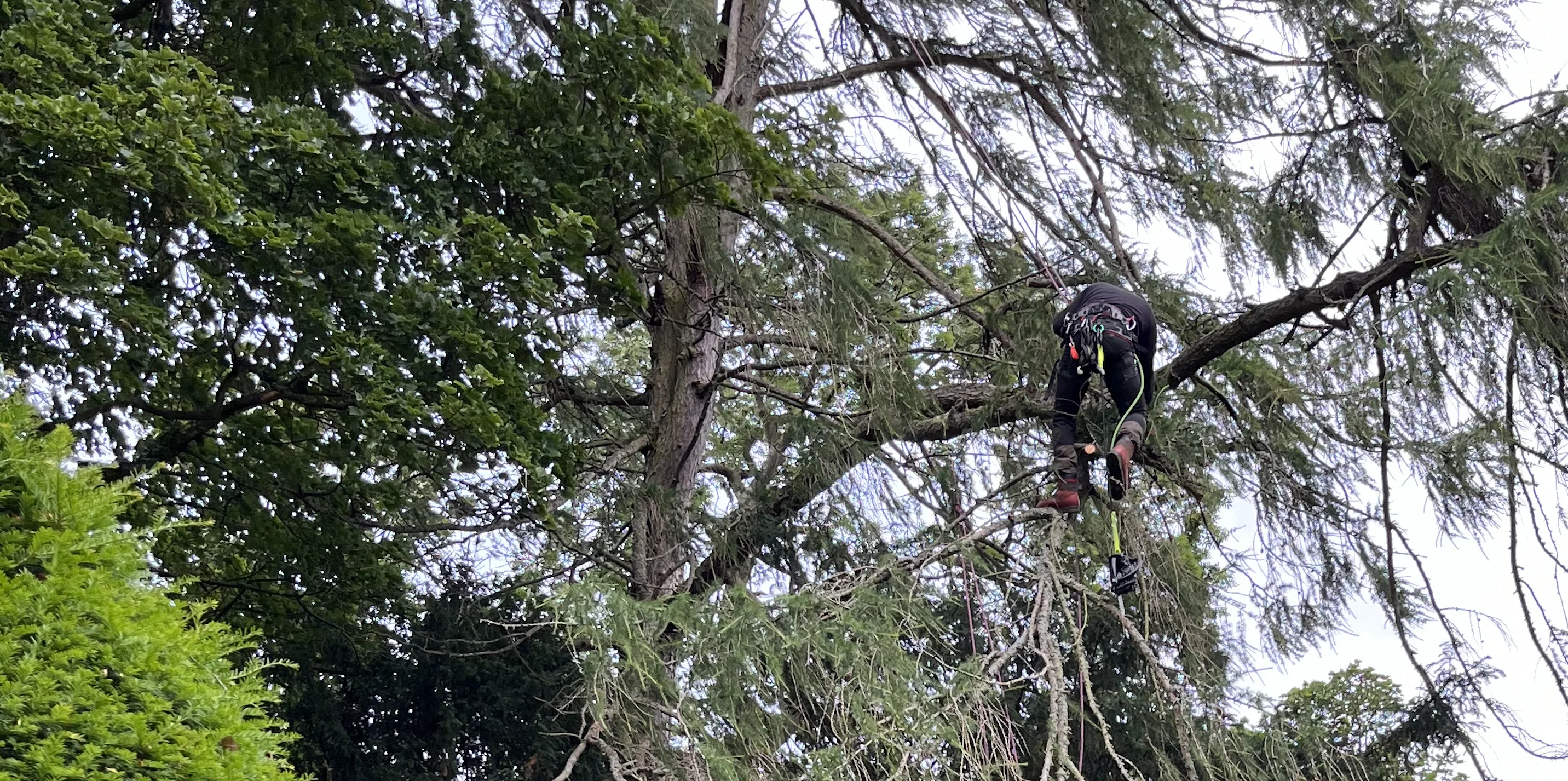
What the work usually is on an estate
- Clearance over hard standing
- Crown lifting over bays, footways, service roads and yards to a stated height. See crown lifting.
- Deadwood over targets
- Dead and hanging limbs over parking and walkways, where failure becomes a claim. See deadwood removal.
- Fence line vegetation
- Self-set growth taken out of fence lines and screen planting brought back. See vegetation management.
- Removal and replacement
- Removal where species and position can’t be reconciled, with a replacement sized for the space.
Car parks, bays and fence lines
The bay is the unit, not the tree
On a live car park the constraint isn’t how long a tree takes. It’s how many bays are out of use for how long, and whether the tenants using them were told. We work bay by bay, cone the drop zone to the smallest genuinely safe area, and sequence so a whole row is never closed at once. Send the bay allocation with the plan: it changes the order of work more than the trees do.
Limes, honeydew and what pruning won’t fix
Sticky cars under limes is the classic complaint. The honeydew is aphid excretion from the foliage, and sooty mould grows on it. Reducing the crown doesn’t stop it: on lime a hard reduction produces a mass of epicormic shoots, that soft growth is what aphids prefer, and within a few seasons the drip is worse than before. The honest options are to live with it, reallocate the affected bays, or remove and replant. Sycamore over bays behaves much the same.
Roots under tarmac and kerbs
Lifted tarmac at the base of a car park tree is a trip claim waiting to happen, and the reflex is removal. Often the cheaper answer is to relay the surface around the roots or reset the kerb line. Cutting roots big enough to have lifted a kerb takes stability with them, and a destabilised mature tree over a full car park is the worse problem.
Fence lines and self-set growth
Boundary fences fail from vegetation more often than from vandalism. Ash and sycamore seed into the fence line, nobody counts them as trees, and at a few inches of stem they’re already through the mesh and pushing posts out of plumb. Taken out early it’s vegetation work; left ten years it’s tree removal plus a fence bill. A fence line is usually a shared boundary, so we confirm ownership before cutting.
CCTV, lighting columns and barriers
Cut to the camera view, not to a specification
A camera field of view is fixed when it is commissioned, and one season of growth can blind it, and nobody notices until footage is needed. Work near cameras shouldn’t be specified in metres. It should be cut with somebody watching the feed and confirming the view is clear before we come down.
Dark pools under canopy
Canopy over a lighting column doesn’t dim the whole car park. It creates dark patches under the affected columns, a personal safety issue for evening staff that reaches you as a complaint about lighting. The fix is clearance above and around the luminaire, not a general reduction. The same goes at barriers and plate readers, where one overhanging branch can be the whole fault.
Service yards, loading bays and bin stores
Yards are where clearance stops being cosmetic. An articulated unit needs its swept path clear on the reverse, not just the straight, and the branch that catches is usually on the inside of the turn where nobody looks. A trailer stands around four and a half metres tall, so headroom has to sit above that with a real tolerance; clearance level with the roof of a trailer isn’t clearance. A limb over a dock gets clipped on every reverse until it fails onto the yard.
Bin stores need more height again, because a refuse vehicle lifts the bin above the hopper inside the compound. Fire escape routes, assembly points and access to sprinkler and riser connections have to stay clear, and get overlooked because nothing parks there.
Access windows and out-of-hours working
The difficulty on a multi-let estate isn’t one operating window, it’s a dozen. A call centre won’t tolerate a chipper at eight in the morning, a distribution unit can’t lose the yard at ten, and a gym car park is busiest when everywhere else is empty. We would rather see the tenant list and the shift pattern than be told the site opens at seven.
Out-of-hours work buys an empty car park and costs more. It has limits we’ll state plainly: we don’t climb or run saws in the dark, and floodlighting a canopy doesn’t make aerial work safe. The useful window is early weekend mornings and daylight evenings, not nights. Security, alarms and gate access need arranging in advance.
Leaf fall, gutters and drainage
Leaf fall on an estate is a drainage event with a date on it. Most of it comes down inside about three weeks in late autumn, gullies and channel drains block in that window, and standing water in the car park arrives the same week. Sequencing beats volume: clearance work before leaf fall, sweeping during it, gullies jetted after rather than before. If the estate drains to an attenuation basin, leaf litter silting the basin reduces the volume it was built to hold.
Box gutters are the expensive one
The costliest tree consequence on a business park isn’t a fallen tree. It’s a branch overhanging a flat roof, filling a box gutter or an internal outlet with leaves, and putting water inside a tenant unit and onto their stock. That’s a claim with business interruption attached, from a branch that would have taken twenty minutes to remove. Any canopy within reach of a flat roof, parapet gutter or rainwater outlet is worth clearing on a cycle.
What drives the price on an estate
We quote per estate and per visit after a walkover. The drivers are tree numbers, size and species; how much work is over live parking and how many bays that takes out; clearance heights required for the actual vehicles; how many separate tenant windows the work has to fit; and out-of-hours working. For a fixed cycle see commercial tree maintenance, and for a documented inspection regime see tree safety inspections.
What isn’t included
Gully jetting, gutter clearing, drain surveys, car park sweeping, fencing and lighting repair aren’t part of a tree work quote, though we’ll say where the tree work needs sequencing with them. Stump grinding is quoted separately: see stump grinding. Traffic management on adopted roads is priced separately.
Commercial cover. NPTC and LANTRA qualified. Constructionline Gold certified. £10M public liability insurance. Site-specific RAMS and written completion reporting.
What customers ask
Common questions
Can you work without closing the whole car park?
Yes, and that’s how we plan it. Work is sequenced bay by bay with the drop zone coned to the smallest safe area, so a full row is never out at once. Send the bay allocation with the site plan, because it changes the order of work.
Will pruning stop the trees dripping sap onto cars?
No. Sticky cars under lime or sycamore come from aphid honeydew on the foliage, and a hard reduction makes it worse by producing soft regrowth that aphids prefer. The real options are accepting it, reallocating the affected bays, or removal and replanting with a different species.
Our CCTV view is obstructed. How do you specify that work?
Not in metres. Put us in touch with whoever can see the camera feed and we cut with them confirming the view is clear before we come down. A few minutes on the phone during the work avoids a revisit and a second mobilisation.
Can you work outside tenant hours?
Yes, at a higher cost, with limits we’ll state up front. We don’t climb or run saws in the dark, so the practical windows are early weekend mornings and daylight evenings rather than nights. Security, gate access and any local noise conditions need arranging in advance.
What clearance height should we specify over the service yard?
It should come from the vehicles, not a standard. An articulated trailer stands around four and a half metres, so the target sits meaningfully above that, and a bin store needs more again because the bin is lifted above the hopper. Tell us the vehicles and routes and we cut to them.
Send the estate plan
Send the site plan, the car park and yard layout, tenant access windows and the security contact. We’ll walk it and price the clearance work in writing.