
Conifer and Leylandii Removal
Conifer and leylandii removal, staged reduction and stump work across County Durham and North Yorkshire. Most conifers won’t regrow from bare old wood.
Send photos of the row from both ends, the approximate height against a fence or gutter, the length of the run and the access width. We’ll confirm whether reduction or removal is the sensible answer.
What our customers say
“I was recommended Ross to cut down and trim a large conifer hedge.”
“He came out quickly after getting in contact to assess what needed doing and provide a quote.”
“Very professional and educated me what was the best way to do the job.”
“He was quick, efficient and did a great job of clearing away.”
“Will definitely be using again and recommending to others.”
- NPTC qualified
- LANTRA qualified
- £10M public liability insurance
- BS3998 standard
Conifer and leylandii removal in County Durham
We remove and reduce conifers and leylandii for homes and gardens across County Durham, North Yorkshire and the Tees Valley. That covers a single conifer taking over a front garden, or a screen row planted thirty years ago that now stands taller than the houses either side.
The first decision is what you want left behind: nothing, a lower screen, or a bare frame to plant against. With most conifers that decision can’t be revised later, so it comes before the method. Send photos from both ends of the run, the height against a fence panel or gutter, the row length and access width.
What the work includes
- Full removal
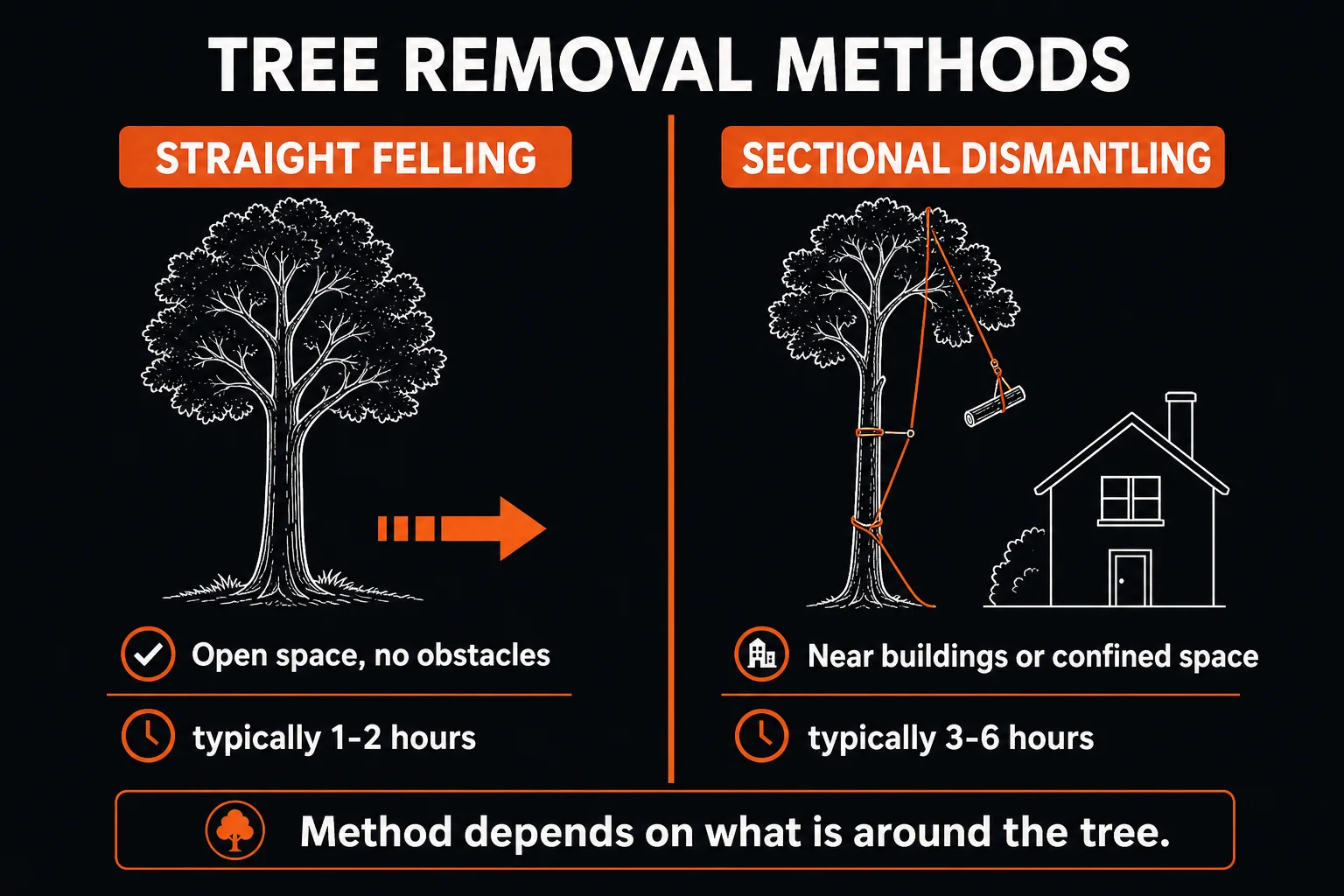
- Each tree taken to ground level, felled where there’s a genuine drop zone or dismantled in sections where fences, sheds, cables or neighbouring gardens are close. See tree removal.
- Height and width reduction
- The top taken out and a target height held, where enough live green growth remains below the cut for the row to still look like a hedge.
- Stems left at height
- The row reduced to bare stems at an agreed height instead of ground level. It keeps a boundary frame and costs less than full removal.
- Waste, stumps and clearance
- Brash chipped, timber cut to length and stacked or taken away, stumps ground where access and underground services allow. See stump grinding.
Why conifers don’t behave like broadleaf trees
Most conifers won’t regrow from old wood
Leylandii, Lawson cypress, thuja and spruce carry their green growth on the outer shell of the tree. Behind it the wood is bare and brown, with no dormant buds in it. Cut past the green and nothing comes back, this season or any season after. Yew is the common exception in a garden boundary and will usually break from old wood. Don’t assume a leylandii behaves like a yew.
A hard cut is a permanent decision
An overgrown beech or hawthorn hedge can be cut hard and will recover, so general advice about renovating a hedge doesn’t transfer. With a conifer the useful question isn’t how far it could come down, but where the lowest live green sits. That line is the floor for any reduction that still looks like a hedge. Below it you’re choosing a brown wall, which is a fair choice if you make it deliberately. The sides behave the same way, so a row that has to come in a long way is often better removed and replanted than cut hard on one face.
Staged reduction and stems left at height
Why staging helps
Staging splits a large row into phases across separate visits. It spreads the cost, keeps some screening while new planting establishes, and lets you see the result before committing to the whole run.
Leaving the stems standing
Taking the row down to bare stems at head height or a little above is a real option. The stems hold the boundary line, carry a fence or wire and give climbers something to grow on, while the crown, weight and shade all go. Grinding can be quoted later if the ground is wanted clear. See hedge care if the row is worth keeping as a maintained hedge instead.
Roots, stumps and the ground underneath
Stump and root handling
A conifer row leaves a line of stumps and a dense mat of surface root. Grinding is the usual answer where a machine can reach and services are clear, so we check for drains, cables, pipes and walls first. Where a stump sits tight against a wall or manhole we quote what can be done rather than promise a clear strip.
The ground the hedge leaves behind
Soil under an established leylandii hedge is dry, shaded and short of nutrients. Improve it before planting rather than turf straight over it, and tell us if a new hedge or fence is going on the line, because that changes how much root comes out.
Permissions before a conifer job starts
Conifers can be protected like any other tree. Work to a tree covered by a Tree Preservation Order needs consent, and in a conservation area a section 211 notice with a six-week period applies first. We check the address and scope before a date is agreed.
We also check for active nests. Under the Wildlife and Countryside Act 1981 it is an offence to damage or destroy an active nest while it is in use or being built, and a dense conifer row is exactly the sort of place birds use.
If a neighbour has complained about the height, that’s a separate process with its own rules. The High Hedges provisions in Part 8 of the Anti-social Behaviour Act 2003 apply in England and Wales, and a remedial notice cannot require a hedge to be cut below two metres and cannot require it to be removed. Our guide to leylandii height law and removal sets out the tests and the council process.
What drives the price
We quote per job after a site assessment. On conifer work the cost is driven less by the number of trees than by two things.
Waste volume
Conifers produce a huge volume of low-density brash for their size, and a mature row can fill a chipper for most of a day. Volume, not weight, fills vehicles and drives disposal, which is why a long low hedge can cost more to clear than a tall tree. Reducing rather than removing, or leaving timber on site as logs, both change that.
Access and the route out
A row behind a house reached through one narrow side gate is a different job from one beside a driveway. Gate width, steps, slopes, soft lawn, parked cars, overhead lines and the carry distance to the vehicle all affect the method and the time. Where a chipper can’t reach the hedge, everything is carried, and that’s the biggest single swing in the price. Height, stem diameter, rigging over a fragile boundary, stump grinding and staging all matter as well, and the written quote states the scope, waste handling, stump treatment and exclusions.
What isn’t included
Fencing, replanting, turfing and landscaping after clearance sit outside this scope, and work to a protected tree without consent or notice in place isn’t carried out. Stump grinding is quoted separately unless the scope says otherwise. Neighbour disputes and high hedges complaints are matters for you and your council. See vegetation management for wider boundary clearance.
See how we carried out a staged conifer removal at a family home in the North East.
Qualifications and cover. NPTC and LANTRA qualified. Constructionline Gold certified. £10M public liability insurance. TPO, conservation-area and nesting checks before work. Written quote before anything is cut.
What customers ask
Common questions
Will a leylandii grow back if I cut it hard?
Almost certainly not. Leylandii and most other conifers hold their green growth on the outer shell of the tree and have no dormant buds in the old brown wood behind it. A cut into bare wood stays bare. Yew is the usual exception in a garden hedge.
Can a conifer row be reduced instead of removed?
Yes, where enough live green growth sits below the target height for the row to still read as a hedge afterwards. We check where the lowest green is before agreeing a height, because that line is the practical limit of any reduction.
What does it mean to leave the stems at height?
The trees are reduced to bare stems at an agreed height instead of taken to ground level. It keeps the boundary line and a frame for planting, removes the crown, weight and shade, and costs less than full removal. Stumps can be ground later if the ground is wanted clear.
Can the council make me remove my leylandii hedge?
No. Under the High Hedges provisions of Part 8 of the Anti-social Behaviour Act 2003, in England and Wales, a council remedial notice cannot require a hedge to be reduced below two metres and cannot require its removal. See our guide to leylandii height law and removal.
How much does conifer removal cost?
We quote per job after a site assessment. Waste volume and access are the two biggest drivers, followed by height, stem size, rigging over fragile boundaries, stump grinding and whether the work is staged. The written quote states the scope and exclusions.
Got conifers that have outgrown the garden?
Send photos of the row from both ends, the approximate height against a fence or gutter, the length of the run and the access width. We’ll confirm whether reduction or removal is the sensible answer.