Crown Reduction
Crown reduction worked to BS 3998 across County Durham and North Yorkshire. Species tolerance, sensible limits and regrowth explained before we quote.
Send photos of the whole tree, its base and what sits underneath it, then tell us what you want changed. We’ll assess the tree and quote the finished crown size in writing.
What our customers say
“I was recommended Ross to cut down and trim a large conifer hedge.”
“He came out quickly after getting in contact to assess what needed doing and provide a quote.”
“Very professional and educated me what was the best way to do the job.”
“He was quick, efficient and did a great job of clearing away.”
“Will definitely be using again and recommending to others.”
- NPTC qualified
- LANTRA qualified
- £10M public liability insurance
- BS3998 standard
What a crown reduction actually does
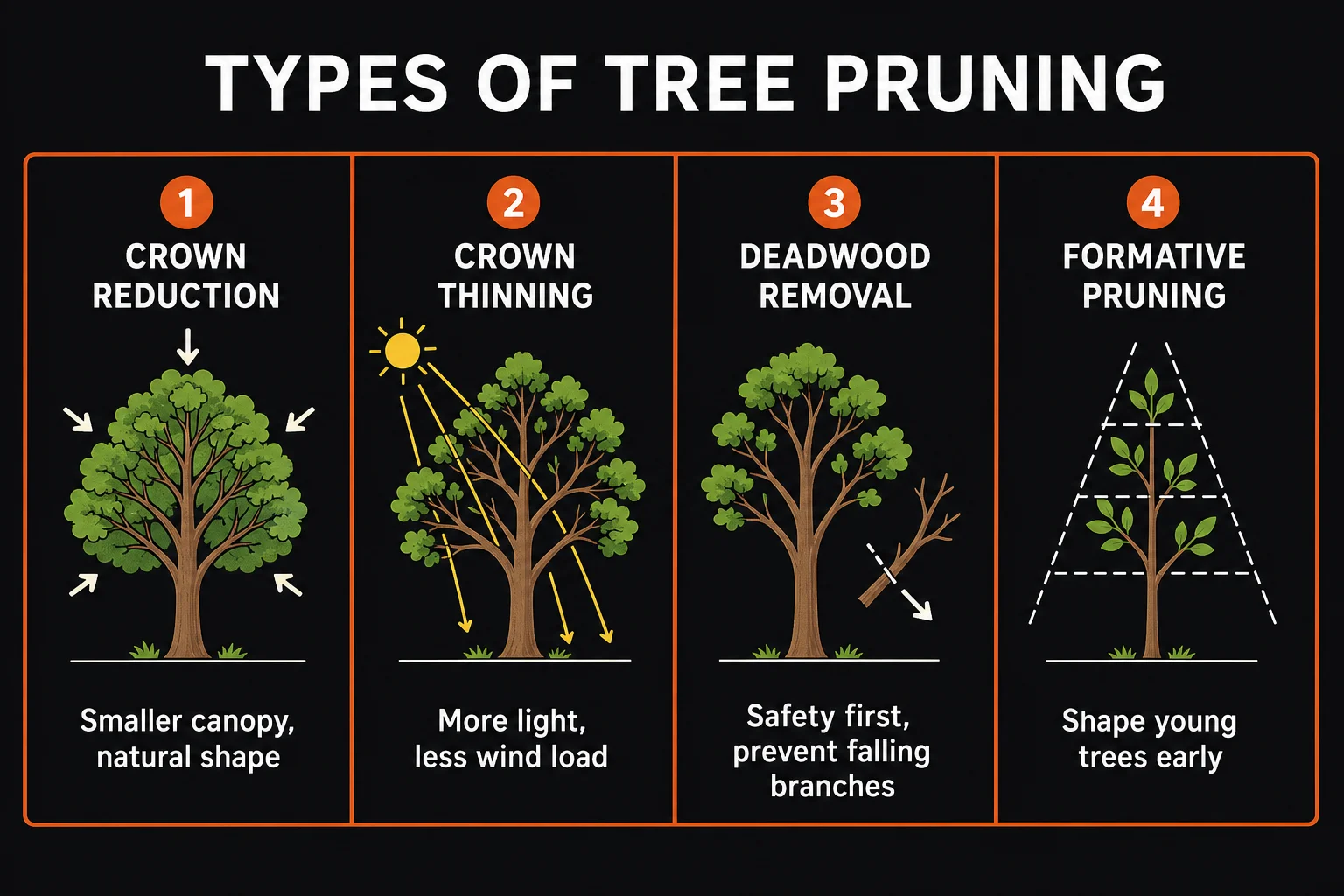
A crown reduction makes a tree smaller in height, spread or both by shortening branches back to suitable growth points. It retains the main framework and a balanced crown rather than cutting the top off. We reduce garden, roadside and commercial trees across North Yorkshire, County Durham and the Tees Valley.
Tell us the problem rather than the treatment. A canopy over a conservatory, a tree taking the afternoon light off a lawn and long limbs sailing above a driveway are different jobs. How much can safely come off is decided by species, condition and where the usable cut points are, not by a percentage agreed before anyone has looked at the tree.
What a reduction includes
- A written specification
- The finished height and spread in metres, or the branch length to be removed, agreed before we start rather than judged from the ground on the day.
- Cuts to suitable laterals
- Every shortened limb ends at a side branch big enough to take over. No stubs, no flat tops, no cutting into bare wood on species that can’t grow back from it.
- Deadwood and defects
- Dead, hung-up and weakly attached wood taken out while we’re already in the crown. See deadwood removal.
- Clearing up
- Brash chipped or taken away, timber cut to length if you want it, and the ground raked off.
Reduction, topping, and the difference between them
Topping cuts a tree off at a chosen height with no regard for where the cuts land. That leaves large open wounds in the main stems and no laterals to take over. Within two or three seasons a mass of shoots springs from around each cut, anchored in outer wood that’s already decaying from the cut face down. The tree ends up more dangerous than it was and needs cutting again sooner. We don’t top trees. The longer comparison is in our article on crown reduction versus topping.
What happens when a reduction is pushed too far
Heavy reduction can leave a tree with too little leaf area, large wounds and vigorous regrowth. Repeated cutting may weaken it without solving the space problem. If a tree is too large for its position, we can discuss tree removal as an alternative.
BS 3998 and why a sensible reduction is limited in extent
BS 3998:2010 is the British Standard for tree work in the UK, and it’s why a good reduction looks more modest than people expect. Two points from it decide most of what happens on site. A reduction should be specified by the size of the crown that remains, or the length of branch removed, not as a loose percentage. And each cut should land at a lateral branch big enough to become the new end of that limb, roughly a third of the diameter of the part removed. Large-diameter cuts into old wood are avoided, because trees don’t close them.
That’s why we’ll sometimes tell you that two metres off the height is reasonable and four metres isn’t, when both are perfectly possible with the same saw.
How we write the specification
We quote in metres against named parts of the crown: the finished height, the spread on the side that matters, and any limb being treated differently. Instructions like "take a third off" are where reductions go wrong, because a third of what is never defined and every climber reads it differently.
Species that take a reduction well, and species that don’t
Species tolerance is the factor most quotes ignore, and it changes the answer more than anything else here.
| Species | Tolerance | What that means on site |
|---|---|---|
| Lime, sycamore, willow, poplar | Good | Close wounds readily and regrow fast. Expect a shorter return cycle. |
| Ash | Reasonable | Tolerant, but condition comes first: a declining tree is an ash dieback decision. |
| Oak | Light only | Slow to close large wounds. Small cut diameters, staged across visits. |
| Beech | Poor | Thin bark scalds, big wounds decay, response growth is sparse. |
| Birch | Poor | Bleeds heavily and decays back from cut ends. |
| Cherry, plum and other Prunus | Poor, timing critical | Silver leaf risk. Light work, mid-summer only. |
| Leyland cypress, spruce, most conifers | None below the green | No regrowth from bare wood, so a cut past the green stays brown. See conifer removal. |
| Yew | Good | The exception among conifers: it regenerates from old wood. |
The inspection that should come before a quote
We start at the bottom, not the top. The base and root plate for lifted soil, cracks or fungal brackets. The stem for cavities, old wounds and bleeding. The main unions for included bark, because a reduction changes how load runs through them. Old cut points and how well the tree closed them, which tells you how it will handle new ones. Leaf size and twig dieback for vitality. What sits under the crown, and whether there are sound anchor points for a climber. Then the address, for a Tree Preservation Order or conservation-area status.
When a reduction isn’t the answer
If vitality is poor, if there’s significant stem decay, or if the species won’t stand what you want taken off, we’ll say so. The alternatives are usually a lighter specification, crown thinning if the real problem is light, crown lifting if it’s clearance, monitoring on a tree maintenance cycle, or removal.
Regrowth, and when to look at the tree again
A reduced tree answers by pushing growth from around the cut points, and vigorous species do it fast. Three to five years is a fair expectation before a garden tree is worth looking at again, but the tree decides that, not the calendar: a warm wet season on a lime will beat any figure we give you.
What the follow-up visit is for
The second visit is smaller work, because the framework is already there. Its real job is thinning the dense clusters of shoots around each old cut, so the weight ends up on a few well-attached stems instead of twenty crowded ones. That’s the difference between a reduction that holds its shape and one that becomes a problem.
Protected trees and nesting birds
Work to a tree covered by a Tree Preservation Order needs consent. In a conservation area it needs a section 211 notice with a six-week period first. A protected tree isn’t untouchable, but the route matters, so we check the address before booking. The Wildlife and Countryside Act 1981 also makes it an offence to damage or destroy an active nest while it is in use or being built, so nesting checks happen before cutting.
What drives the price
We quote per job after a site assessment. The cost follows tree height and crown size, the number of cuts, species and how the arisings handle, access for people and equipment, whether the tree is climbed or reached with a machine, what is beneath the crown and needs protecting, brash volume and where a chipper can stand, and any traffic or footpath control. Several trees on one visit costs less per tree than one at a time.
What isn’t included
A reduction covers the reduction. Opening a dense canopy for light and clearing branches off a path or roof are separate specifications: see crown thinning, crown lifting and the full range on our tree pruning page. Felling and stump work are quoted through tree removal and stump grinding, and hedges under hedge care. Work on a protected tree without consent isn’t included, and neither is pollarding, which is a different operation with different consequences.
Pruning standards. NPTC and LANTRA qualified. Constructionline Gold certified. £10M public liability insurance. Work specified to BS 3998 and quoted in writing before it starts.
What customers ask
Common questions
How much can be taken off in a crown reduction?
It depends on the species, condition and suitable cut points. We agree a finished height and spread in metres after inspecting the tree, and explain if the reduction you have in mind would damage it.
Is crown reduction the same as topping?
No. Topping cuts stems off at a chosen height and leaves large wounds with no laterals to take over, which produces weakly attached regrowth and decay. Reduction shortens branches back to growth points that can take over, keeping the tree structurally sound. We don’t top trees.
How often will a reduction need doing again?
Three to five years is a reasonable expectation for a vigorous garden tree, and longer for a slow species worked lightly. The follow-up visit is smaller work, because the framework is already there and the regrowth clusters just need thinning back to a few strong stems.
Which trees shouldn’t be heavily reduced?
Beech, birch and cherry all respond badly to hard cutting, and oak should have small cut diameters only. Leyland cypress, spruce and most other conifers cannot regrow from bare wood at all, so anything cut back past the green stays brown permanently.
Do I need permission for a crown reduction?
You do if the tree has a Tree Preservation Order, and a conservation-area tree needs a section 211 notice with a six-week period first. We check the address and the proposed work before booking and explain which route applies.
Get a crown reduction quote
Send photos of the whole tree, its base and what sits underneath it, then tell us what you want changed. We’ll assess the tree and quote the finished crown size in writing.