
Areas We Cover in County Durham & North Yorkshire
The towns and villages we work in across County Durham, the Tees Valley and North Yorkshire, which council covers your tree, and how travel affects a quote.
Send the postcode, photos of the tree and a photo of the access route. We’ll tell you straight away whether the job suits our team and equipment.
What our customers say
“I was recommended Ross to cut down and trim a large conifer hedge.”
“He came out quickly after getting in contact to assess what needed doing and provide a quote.”
“Very professional and educated me what was the best way to do the job.”
“He was quick, efficient and did a great job of clearing away.”
“Will definitely be using again and recommending to others.”
- NPTC qualified
- LANTRA qualified
- £10M public liability insurance
- BS3998 standard
Where we cover: County Durham, the Tees Valley and North Yorkshire
Most tree surgeons say "and surrounding areas" and leave you to guess. This page names the towns and villages we work in, says where the bulk of the work sits, tells you which council decides protected-tree questions at your address, and explains what travel and access do to a quote.
The honest shape is a band of roughly 30 miles centred on the Darlington and Durham corridor: Barnard Castle west, Richmond and the lower Swale south, Stockton-on-Tees east, Chester-le-Street and Consett at the northern edge. If your village isn’t named here, send the postcode anyway. Whether a job at the edge of that band works depends on the size of the work and the access, not the mileage.
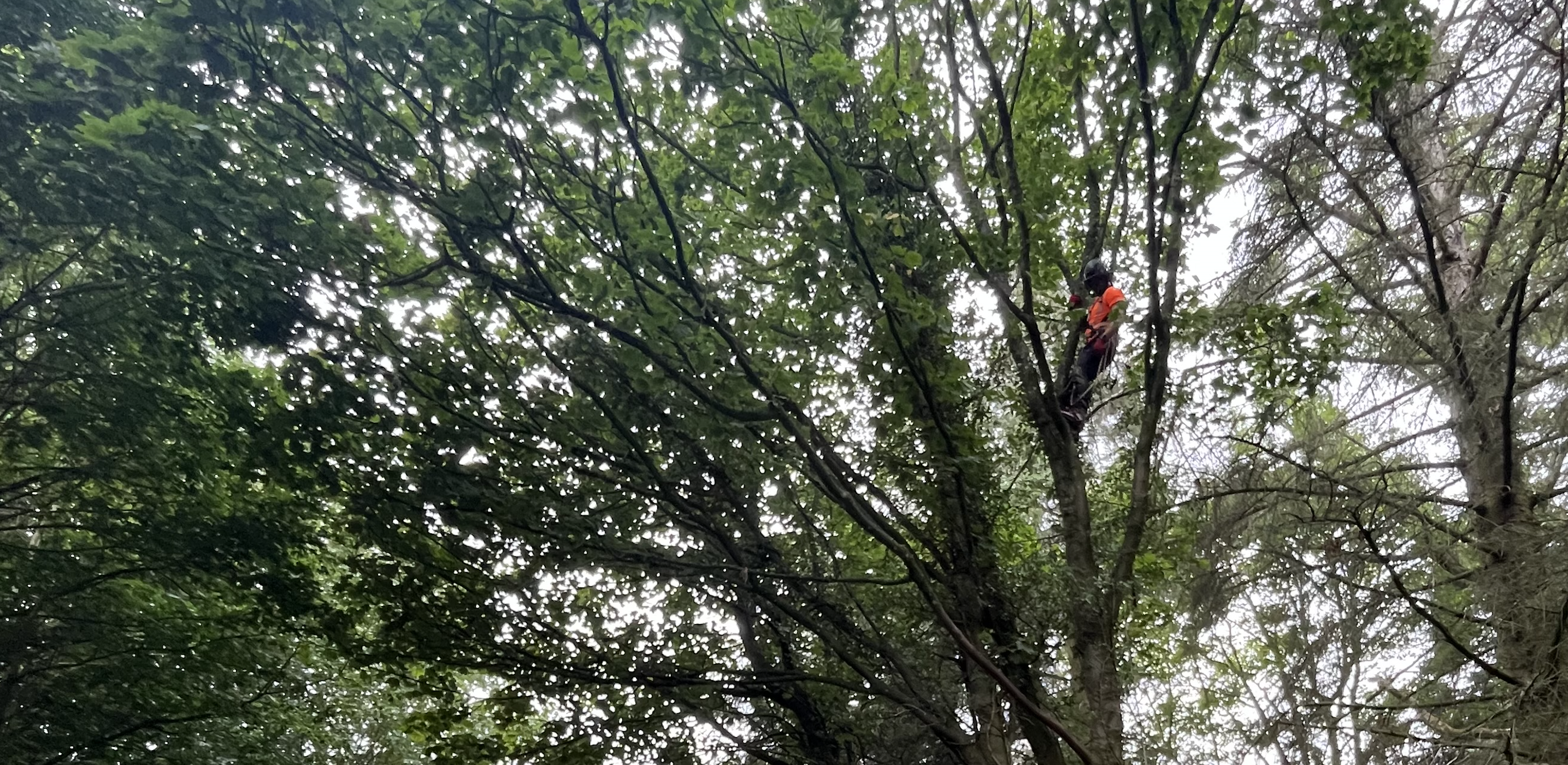
Work we carry out across the whole area
- Tree removal and felling
- Straight felling where there’s a safe drop zone, sectional dismantling where a building or road is close. See tree removal.
- Pruning and crown work
- Reduction, thinning, lifting and deadwood removal where the tree is worth keeping. See tree pruning.
- Hedges, conifers and vegetation
- Trimming, staged reduction, conifer removal and boundary clearance. See hedge care.
- Storm and emergency response
- Made safe first, cleared afterwards, priority set by the hazard. See emergency tree work.
Towns we work in
County Durham
Durham, Bishop Auckland, Barnard Castle, Chester-le-Street, Consett, Newton Aycliffe and Spennymoor. The first three have their own pages with the local detail. Durham city brings the most conservation-area work, because much of the centre and older suburbs are designated and the garden trees there are mature. Chester-le-Street and Consett sit at the northern edge: the work is doable, but one small job that far out may wait for a day we’re already working that way.
Darlington and the Tees Valley
Darlington, Stockton-on-Tees and the villages between them. Darlington is our centre of gravity, and the pattern is consistent: interwar and post-war gardens with a sycamore, ash or lime that was a sensible size fifty years ago and now stands over a roof or a boundary. Stockton work sits mainly in the villages north of the town.
Richmond and the North Yorkshire side
Richmond, the lower Swale villages and the parishes south of the Tees. The most rural part of the patch: field-boundary ash, riverside sycamore and shelter belts rather than street trees, often with a farm track as the only way in. Ash dieback runs heavily through these hedgerow lines, and roadside ash is the job most often dealt with in a hurry. Estate and site work is covered on our North Yorkshire commercial page.
The villages around Darlington, where most of our work is
This ring is the densest part of the map for us, and worth saying so rather than pretending coverage is even. Travel is short, we know the lanes, and we’re often in the ring already.
North and east of Darlington
Great Burdon, Barmpton and Great Stainton. Hedgerow and field-edge trees dominate, and the usual job is a roadside or boundary tree rather than a garden specimen. Great Stainton, despite sitting closer to Darlington than anywhere else, falls under Durham County Council, which matters if the tree turns out to be protected.
South of the Tees, Hurworth to Dalton
Hurworth-on-Tees, Low Dinsdale, Sockburn and Dalton-on-Tees. Large gardens, riverside boundaries and some very big mature limes. The constraint here is ground rather than access: much of this land is flood plain, and after a wet spell a tipper or tracked machine will churn a lawn. Where that’s the case we’ll either work in a drier window or lower and carry instead of driving in. Dalton-on-Tees is over the river in North Yorkshire, even though it works as a Darlington village.
Aycliffe Village and the road north
Aycliffe Village, Newton Aycliffe and Shildon. Much of the planting went in during the fifties and sixties, so what we’re called to is trees and conifer rows that have outgrown the plot. Staged reduction over more than one visit is often a better answer than removal, and it spreads the cost.
Other villages in the patch
Sedgefield, Ferryhill, Coxhoe and Bowburn along the corridor between Durham and Darlington, and Wolviston on the Stockton side. In the older terraced villages the limiting factor is almost never distance: it’s a narrow back lane, a shared yard, or no vehicle access to the rear at all, so the chipper and tipper work off the front street and the timber is carried out. That changes the time on site, so mention it early.
Which council covers your tree
| Where the tree is | Council for TPO and conservation-area work |
|---|---|
| Durham, Chester-le-Street, Consett, Bishop Auckland, Barnard Castle, Newton Aycliffe, Aycliffe Village, Spennymoor, Shildon, Sedgefield, Ferryhill, Coxhoe, Bowburn, Great Stainton | Durham County Council |
| Darlington, Great Burdon, Barmpton, Hurworth-on-Tees, Low Dinsdale, Sockburn | Darlington Borough Council |
| Richmond, the lower Swale villages, Dalton-on-Tees and the parishes south of the Tees | North Yorkshire Council |
| Stockton-on-Tees and Wolviston | Stockton-on-Tees Borough Council |
The council holds the Tree Preservation Orders and the conservation-area designations. Work to a tree under a TPO needs a consent application. Work in a conservation area needs a section 211 notice, with a six-week period before it can go ahead. A protected tree isn’t untouchable, but the route has to be followed and the six weeks can’t be shortened.
Boundaries don’t always follow the postal address, and these four authorities meet untidily around Darlington and the Tees, so we check the address against the council's map before quoting protected work.
Hedge height complaints go to the same council
A neighbour's hedge blocking light is a complaint to the council in the table, under the High Hedges provisions of Part 8 of the Anti-social Behaviour Act 2003, which apply in England and Wales. Two limits are worth knowing first: a remedial notice cannot require the hedge to be reduced below two metres, and it cannot require the hedge to be removed. Our domestic hedge cutting rules article sets out what applies to a garden hedge.
What travel and access do to a quote
Access decides more of the price than distance does
We quote per job after a site assessment. On an outlying job the drivers are the width of the lane and gateway, whether the tipper and chipper can reach the tree or the arisings have to be carried, the ground conditions, and whether the road needs control. A tree at the far edge of the area with a field gate beside it’s straightforward. The same tree behind a terrace with no rear access isn’t.
How outlying jobs get scheduled
Travel time is real, and pretending otherwise leads to a price that changes later. For a small job at the outer edge we’ll usually offer a date when we’re already working that way, or suggest grouping it with a neighbour's. On anything substantial, travel makes little difference to the total.
What this doesn’t mean
We aren’t a national outfit and don’t cover the whole North East. Beyond the band above we say no rather than take the booking and be late, and we don’t travel out of area for urgent work while an urgent job closer to home waits. For what to check before hiring anybody, including the credentials we don’t hold, see what to check before you hire a tree surgeon.
Qualifications and cover. NPTC qualified. LANTRA qualified. Constructionline Gold certified. £10M public liability insurance. Site-specific risk assessment and a written quote before work begins.
What customers ask
Common questions
My village isn’t on your list. Do you still cover it?
Probably, if it sits inside the band described on this page. The list names the places we work in most often, not the only places we go. Send the postcode with photos of the tree and the access, and we’ll tell you whether the job suits our team and equipment rather than leave you guessing.
Do you charge extra for travel?
We quote per job after a site assessment and the price is confirmed in writing before work starts. Travel time is one of the things behind that figure on a job at the outer edge of the area, but access, ground conditions, waste volume and the method the tree needs usually matter more. For a small job a long way out we’ll often offer a date when we’re already working in that direction.
Which council do I contact about a protected tree?
Durham County Council for most of County Durham including Bishop Auckland, Barnard Castle, Consett, Chester-le-Street, Sedgefield and Great Stainton. Darlington Borough Council for Darlington and its own villages such as Hurworth-on-Tees, Low Dinsdale and Great Burdon. North Yorkshire Council for Richmond, Dalton-on-Tees and the parishes south of the Tees. Stockton-on-Tees Borough Council for Stockton and Wolviston. We check the address against the council map before quoting protected work.
How far will you travel for emergency tree work?
Priority goes to the hazard and how quickly we can reach it, so a storm-damaged tree in the Darlington villages will normally be reached before one at the far northern edge of the area. Call with photos if it’s safe to take them, never approach a tensioned or partly fallen tree, and see our emergency tree work page for what happens on arrival.
Do you work south of the Tees in North Yorkshire?
Yes. Dalton-on-Tees and the parishes along that stretch of the river are regular ground for us, and we work the Richmond and lower Swale area as well. Those addresses come under North Yorkshire Council for TPO and conservation-area purposes. Commercial and estate work in the county is covered on our North Yorkshire commercial page.
Not sure whether we cover your village?
Send the postcode, photos of the tree and a photo of the access route. We’ll tell you straight away whether the job suits our team and equipment.