Qualified Tree Surgeon: What to Check Before You Hire
What a qualified tree surgeon should be able to show you: NPTC and LANTRA certificates, £10M public liability, Constructionline Gold and site-specific RAMS.
Send the tree, the location and the access route, and ask for whatever you want to see. Certificates, the insurance schedule and the RAMS come with the written quote.
What our customers say
“I was recommended Ross to cut down and trim a large conifer hedge.”
“He came out quickly after getting in contact to assess what needed doing and provide a quote.”
“Very professional and educated me what was the best way to do the job.”
“He was quick, efficient and did a great job of clearing away.”
“Will definitely be using again and recommending to others.”
- NPTC qualified
- LANTRA qualified
- £10M public liability insurance
- BS3998 standard
How to check a tree surgeon is qualified and insured
There’s no licence to trade as a tree surgeon in the UK. Anyone can put the words on a van. What exists instead is proof of competence, unit by unit, and insurance that’s current and covers the work quoted. Both are documents, and you can ask to see them before anyone cuts.
It sets out what we hold, what each document certifies, and what to ask anyone quoting on your trees.
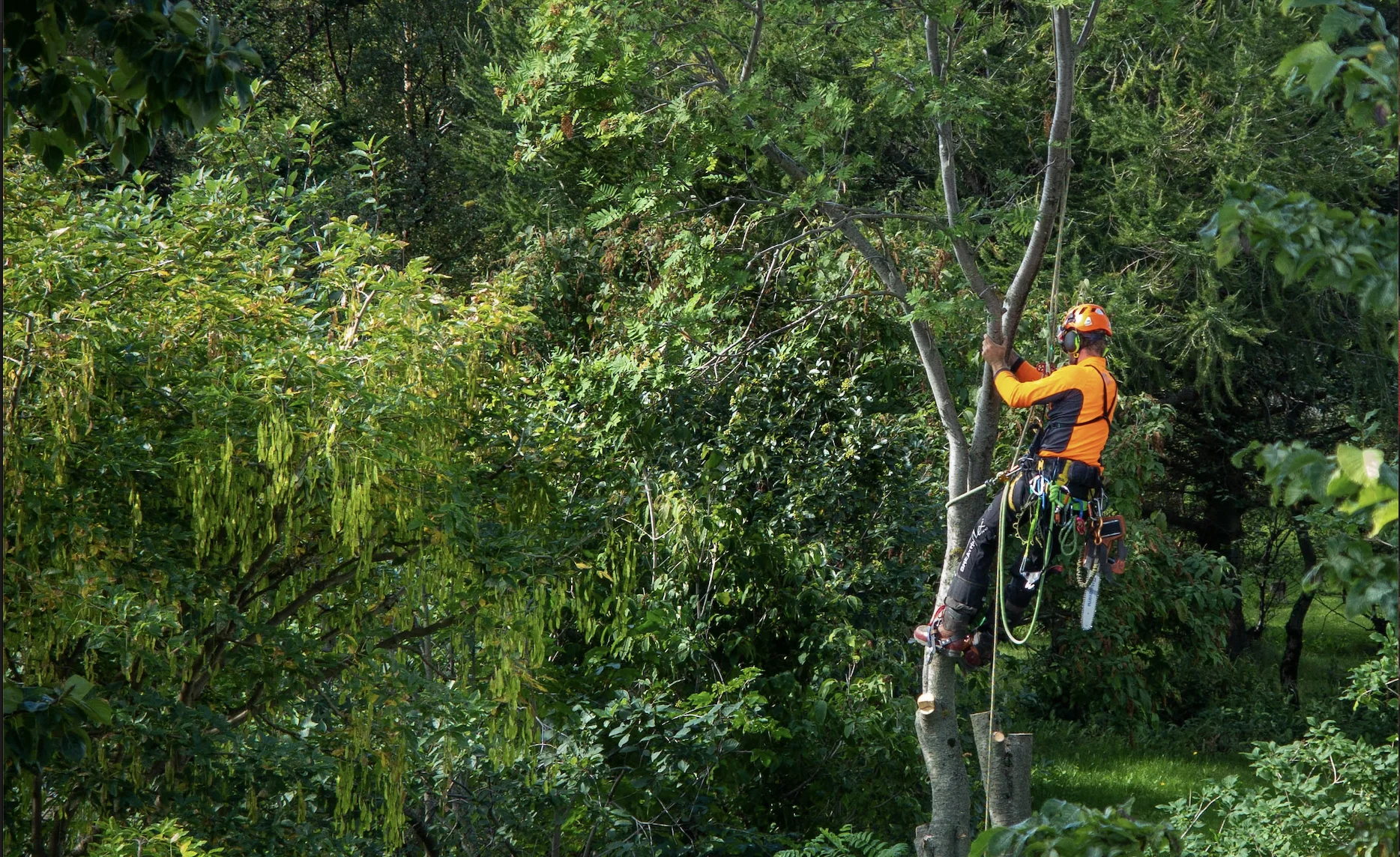
What we hold
- NPTC certificates of competence
- Practically assessed, covering chainsaw use, felling, climbing and aerial cutting.
- LANTRA qualified
- Assessed training through the awarding body for land-based work.
- Constructionline Gold
- Third-party assessed pre-qualification, renewed annually.
- £10M public liability insurance
- Injury to others and damage to their property arising from our work.
- Site-specific RAMS
- Written for your site, not a template. Standard on commercial tree surgery, on request for domestic work.
What NPTC and LANTRA actually certify
NPTC certificates are issued one unit at a time
NPTC certification is assessed practically, by an external assessor, unit by unit. Chainsaw maintenance and crosscutting is one unit. Felling is another. Climbing and aerial rescue is another again, and cutting from a rope and harness separate from all of them.
So "NPTC qualified" alone doesn’t answer the question. Someone certificated to crosscut timber on the ground isn’t certificated to take a limb off over a conservatory. Ask which units cover the method your tree needs.
LANTRA awards, and how they differ
LANTRA is the awarding body for land-based work, so the difference is which body issued the certificate, not which is worth more. LANTRA more often covers the machinery around the cutting, such as chippers, stump grinders and first aid; NPTC covers the aerial chainsaw units. Neither lapses like an MOT, so refresher training matters as much as the certificate date.
What £10M public liability cover means in practice
Why £10M is the commercial threshold
£10M is the figure written into most commercial, local-authority and main-contractor requirements. It’s a procurement threshold, not a measure of skill: one incident involving a highway, a building or a buried service can run past a smaller limit.
What the cover doesn’t do
It isn’t employers' liability, a separate compulsory policy where a firm has staff, nor professional indemnity, which covers written advice. Check the dates, the business name on the certificate, and that chainsaw use and work at height aren’t excluded. Some policies exclude work above a stated height, which makes the certificate useless for your job.
Constructionline Gold, and who asks for it
Constructionline is a supplier pre-qualification database. Gold means a third party has assessed our company information against the industry Common Assessment Standard question set — health and safety management, insurances, financial standing and company policies — renewed annually. Local authorities, housing providers and main contractors ask for it because it saves them running their own questionnaire. Domestic customers almost never do, and that’s fair: it says our paperwork and safety management have been checked independently, not that our pruning is good.
Site-specific RAMS, and when you should expect one
What a real method statement contains
A method statement worth reading names your tree and your site: the exclusion zone and who holds it, the cutting sequence, whether the tree is felled whole or dismantled in sections, plant positions, overhead lines and buried services, and an emergency plan carrying the site address.
The aerial rescue question almost nobody asks
A climber can’t rescue himself. Where someone works aloft with a chainsaw, a second trained person should be on the ground able to carry out an aerial rescue. A quote that’s cheap because one man is going up alone is cheap for that reason.
When a domestic job needs the document
Every job is assessed. Not every job needs a bound document, and a hedge trim in an enclosed garden doesn’t. Anything with public access, a highway, a shared drive or a neighbour's roof in the working area does.
Credentials we don’t hold
Arboricultural Association Approved Contractor
We aren’t an ARB Approved Contractor. It’s a genuine scheme: the Arboricultural Association audits firms on work quality, business practice and safety. It’s the credential most visible on tree surgery websites, and a fair thing to ask about. If it’s a condition of your procurement, tell us at enquiry stage.
DBS checks
We aren’t DBS checked. If your site needs DBS-checked contractors, as many schools and care settings do during occupied hours, we aren’t the right contractor for that job. We would rather say so now than at the gate.
What to ask before you let anyone start
- Which certificates cover this method? The units, not the phrase.
- Can I see the insurance certificate? Dates, business name, height or chainsaw exclusions.
- Who is on the ground while someone climbs? Aerial rescue cover, by role.
- Is the tree protected? A Tree Preservation Order or conservation area changes the route before the price.
- Is the quote written? A scope that doesn’t state its exclusions isn’t a scope.
Warning signs of an uninsured or unqualified operator
- The paperwork never appears. The insurance is in the van, or the certificate arrives with the dates cropped off.
- Cash only, deposit first, no written scope.
- An offer to top the tree. Topping isn’t a reduction, and a certificated climber knows what it does. See crown reduction versus topping.
- Ladders, spikes and missing kit. A chainsaw off a ladder, climbing irons on a tree being retained, nobody on the ground.
- Storm door-knocking with a price that expires today. Genuine emergency tree work is urgent about the hazard, not your signature.
What qualifications and cover do to the price
We quote per job after a site assessment. None of this shows as a line on the quote; it sets the floor under it. What moves the price is the method the tree needs, such as a straight fell into a clear drop zone against a sectional dismantle over a boundary, how many certificated people that takes, access, waste volume and any traffic control. A quote well under the others is usually cheaper for a reason you can name.
What we don’t offer, and what our evidence is
What a consultation with us is, and isn’t
A site assessment and a written quote for work, not an arboricultural report. We don’t produce mortgage, subsidence or ecology reports; for a BS5837 survey see tree surveys for planning. Our published staged conifer removal case study records 21 conifers taken down in stages on a North East domestic property. It’s one job, labelled as what it’s, and no substitute for the certificates. We work across County Durham, North Yorkshire and the Tees Valley, so check areas we cover first.
Qualifications and cover. NPTC qualified. LANTRA qualified. Constructionline Gold certified. £10M public liability insurance. Site-specific RAMS and a written quote before work begins. Not ARB Approved and not DBS checked, and we say so before you ask.
What customers ask
Common questions
Is there a legal qualification you must hold to work as a tree surgeon?
No. There’s no licence to trade as a tree surgeon in the UK. The law requires competence, and competence is evidenced by assessed certificates for each separate task. The useful check is which units the person holds for the method your tree needs.
What is the difference between NPTC and LANTRA?
They’re two awarding bodies rather than two levels. NPTC certificates are practical, externally assessed and issued unit by unit, and the aerial chainsaw units are usually NPTC. LANTRA more often covers machinery and site skills such as chippers, stump grinders and first aid. Competent outfits carry a mix of both.
Why does £10M public liability matter on a domestic job?
£10M is the level written into most commercial and local-authority requirements, so it is the policy a firm equipped for managed sites already carries. On a garden job it means the cover sits well above the exposure. Check the dates, the business name and that tree work at height isn’t excluded.
Are you an Arboricultural Association Approved Contractor?
No. We aren’t ARB Approved and we don’t claim to be. We hold NPTC and LANTRA certification, Constructionline Gold and £10M public liability cover. If ARB Approved status is a condition of your procurement, tell us at enquiry stage and we’ll say honestly whether we can meet it.
Will you provide a RAMS for work at my house?
Every job is risk assessed. A site-specific RAMS is standard on commercial work and we can provide one for domestic work on request. Ask for it where there’s public access, a highway, a shared drive or a neighbouring roof inside the working area.
Ask us for the paperwork
Send the tree, the location and the access route, and ask for whatever you want to see. Certificates, the insurance schedule and the RAMS come with the written quote.