
Crown Thinning
Crown thinning to cut canopy density and let light through while the outline of the tree stays as it’s. County Durham and North Yorkshire. Quoted per job.
Tell us which room or which part of the garden is losing light, and send a photo of the tree from that spot. We’ll assess the crown and quote the work in writing.
What our customers say
“I was recommended Ross to cut down and trim a large conifer hedge.”
“He came out quickly after getting in contact to assess what needed doing and provide a quote.”
“Very professional and educated me what was the best way to do the job.”
“He was quick, efficient and did a great job of clearing away.”
“Will definitely be using again and recommending to others.”
- NPTC qualified
- LANTRA qualified
- £10M public liability insurance
- BS3998 standard
What crown thinning does, and what it doesn’t do
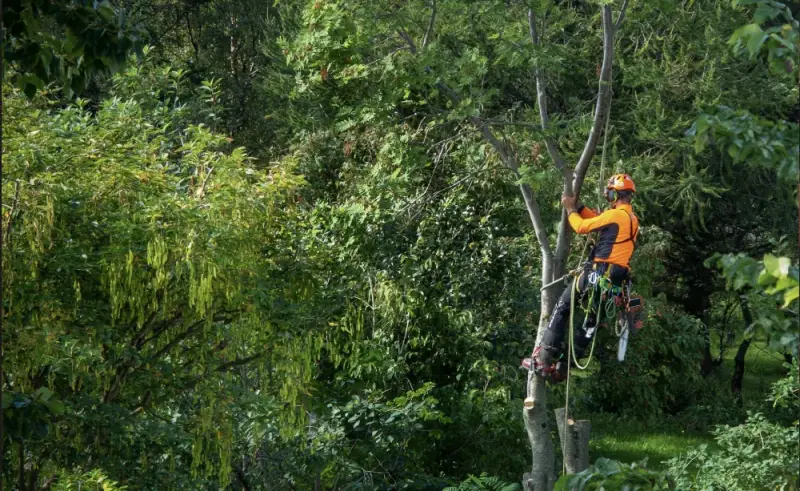
Crown thinning removes selected smaller branches within the crown to reduce its density. The tree keeps its height and outline, but more light can pass through the canopy.
That distinction decides which job you actually need. If the tree is too big for the space, thinning won’t fix it and you want a crown reduction. If the trouble is branches over a path or a drive, you want crown lifting. Thinning is for a congested canopy that’s casting heavy shade, holding more wind than it should, or hiding a structural problem we need to see. We thin trees for homes, schools and managed sites across County Durham, North Yorkshire and the Tees Valley.
What a thinning job includes
- Secondary branchwork
- Selected small-diameter branches removed from throughout the crown, cut back to their point of origin so nothing is left as a stub.
- Crossing and rubbing limbs
- Branches wearing against each other go first. That buys density reduction and takes out a defect in the same cut.
- Deadwood and epicormic clusters
- Dead wood, hung-up material and thickets of weak shoots around old wounds cleared while we’re in the tree. See deadwood removal.
- Even distribution
- The thin is spread across the whole crown, top to bottom and all the way round, rather than taken out of whichever side is easiest to reach.
How a thin is specified, and why we state a proportion
BS 3998:2010 treats thinning as the removal of a proportion of the secondary branchwork, distributed as evenly through the crown as the tree allows. We quote it that way: a stated proportion of the leaf-bearing branchwork, worked evenly, with the outline left alone. Anything beyond a light to moderate thin at one visit is better split into two visits a few years apart. The canopy is the food supply, and taking a lot of it at once has a cost that shows up later.
Over-thinning
A crown stripped too hard reacts the way any tree reacts to sudden loss of leaf area. You get a rush of epicormic shoots, usually where you least want them, and a canopy denser three years on than it was before the work. Bark that spent decades in shade is exposed to direct sun and scalds, and the thin-barked species are the ones it happens to. You paid for light and bought yourself a bushier tree.
Lion tailing, and why we won’t do it
Lion tailing is the shortcut version of a thin: strip the inner laterals out along each limb and leave a tuft of foliage at the tip. It looks tidy from the ground and it’s poor work. The weight and the wind load now sit at the far end of a bare lever arm, the limb has lost the interior growth that damped its movement in a gust, and the newly exposed upper bark scalds. Branch failures in lion-tailed trees are a familiar call-out. If a quote for thinning describes stripping branches out and leaving the ends, that’s what is being sold.
Which trees suit a thin
Broadleaves with dense crowns
Sycamore, lime, horse chestnut, Norway and field maple, and older hawthorn carry the sort of congested secondary growth a thin was designed for. They respond predictably, and the change in light is noticeable from inside a house rather than only from the garden.
Thin-barked and slow-responding species
Beech and birch will take a light thin and object to a heavy one, mostly through sunscald and poor wound closure. Cherry and plum are worked in mid-summer only, because of silver leaf. On oak we keep cut diameters small and accept that the effect is subtle.
Conifers
Thinning isn’t a conifer operation. Leyland cypress, spruce and most others carry foliage only on the outer shell of the crown and can’t regenerate from the bare wood inside it. There’s nothing in there to thin, and any cut past the green stays brown. For a conifer problem the honest options are a reduction that stays within green growth, or conifer removal.
Timing, and the light you’ll actually get
Structure reads best with the leaves off, so winter suits the cutting. Density and shading read best with the leaves on, so summer often suits the assessment. Either way an active nest stops the job: the Wildlife and Countryside Act 1981 makes it an offence to damage or destroy a nest while it is in use or being built, and requests for more light arrive in exactly the months when nests are there.
Be realistic about the outcome. A thin gives broken, dappled light, not open sky. On a north-facing garden in midwinter it may give you very little. We would rather say that at the assessment than take the money and disappoint you. If you need a step change in light, the conversation is about a reduction, a lift, or whether the tree is in the right place at all.
The inspection before the quote
Thinning is only sensible on a tree with the vitality to carry it, so the assessment is mostly about condition. We look at leaf size and colour, how far twig dieback extends into the outer crown, the ratio of live crown to total height, old cut points, unions with included bark, and the base for fungal brackets. A tree already in decline gets less work, not more.
We also check the address before quoting. Thinning is pruning, and pruning a tree with a Tree Preservation Order needs consent, while a tree in a conservation area needs a section 211 notice with a six-week period. Neither is a refusal, but both have to happen before the saw comes out.
What drives the price
We quote per job after a site assessment. Crown size and height, the number of trees, how congested the crown is, the proportion being removed, whether it’s climbed or needs a machine, brash volume and where a chipper can stand all move the figure. Thinning several trees on one visit costs less per tree than one at a time, which is why it often sits inside a tree maintenance cycle.
What isn’t included
Thinning is thinning. Making the tree smaller, clearing branches off a roof or a footpath, felling and stump work are separate scopes: see crown reduction, crown lifting, tree removal and stump grinding. General pruning options are set out on our tree pruning page, and hedges under hedge care. Where a decision needs a formal report first we also provide tree surveys. Work on a protected tree without consent isn’t included in any quote.
Pruning standards. NPTC and LANTRA qualified. Constructionline Gold certified. £10M public liability insurance. Thinning specified as a proportion of the crown, in writing, before work starts.
What customers ask
Common questions
Will crown thinning make my tree smaller?
No. Thinning reduces density inside the crown while retaining its height and outline. If you want a smaller tree, ask us about crown reduction instead.
How much of a crown can be thinned at once?
We quote a stated proportion of the secondary branchwork, worked evenly through the crown. A light to moderate thin is the safe range for most trees at one visit. Where more is wanted, we stage it across two visits a few years apart.
Will a thinned tree grow back thicker than before?
It can, if too much came off. Hard thinning triggers epicormic shoots that fill the crown in again within a few years. A measured thin regrows slowly and holds its effect for much longer.
Can you thin a leylandii or other conifer?
No. Conifers of that sort carry foliage only on the outer shell of the crown and can’t regrow from the bare wood inside, so there’s nothing to thin and any cut past the green stays brown. Reduction within the green growth or removal are the realistic options.
How much more light will thinning give me?
Broken, dappled light rather than open sky. How much difference you notice depends on the aspect, the distance from the window, the species and the time of year. We give an honest view at the assessment before you commit to the work.
Ask about crown thinning
Tell us which room or which part of the garden is losing light, and send a photo of the tree from that spot. We’ll assess the crown and quote the work in writing.