
Tree Surgery for Caravan and Holiday Parks
Tree work for caravan and holiday parks in County Durham and North Yorkshire, planned around your closed season, pitch plan and what insurers ask to see.
Send the pitch plan with the problem pitches marked, your season dates and where a chipper and tipper can stand. We’ll walk the park and quote in writing.
What our customers say
“I was recommended Ross to cut down and trim a large conifer hedge.”
“He came out quickly after getting in contact to assess what needed doing and provide a quote.”
“Very professional and educated me what was the best way to do the job.”
“He was quick, efficient and did a great job of clearing away.”
“Will definitely be using again and recommending to others.”
- NPTC qualified
- LANTRA qualified
- £10M public liability insurance
- Constructionline Gold certified
- RAMS as standard
Tree surgery for caravan parks and holiday parks
Park tree work is rarely hard because the tree is hard. It’s hard because the thing under the branch can’t be moved, the park is only shut for a few weeks, and those weeks are the wettest of the year. We work for caravan, holiday and lodge park operators across County Durham, North Yorkshire and the Tees Valley.
Send your pitch plan with the affected pitches marked, your season dates and where our vehicles can stand. We walk the park with your manager, agree a pitch-by-pitch sequence and quote in writing. If nothing has failed yet and you want to know what you’re carrying, start with a walkover.
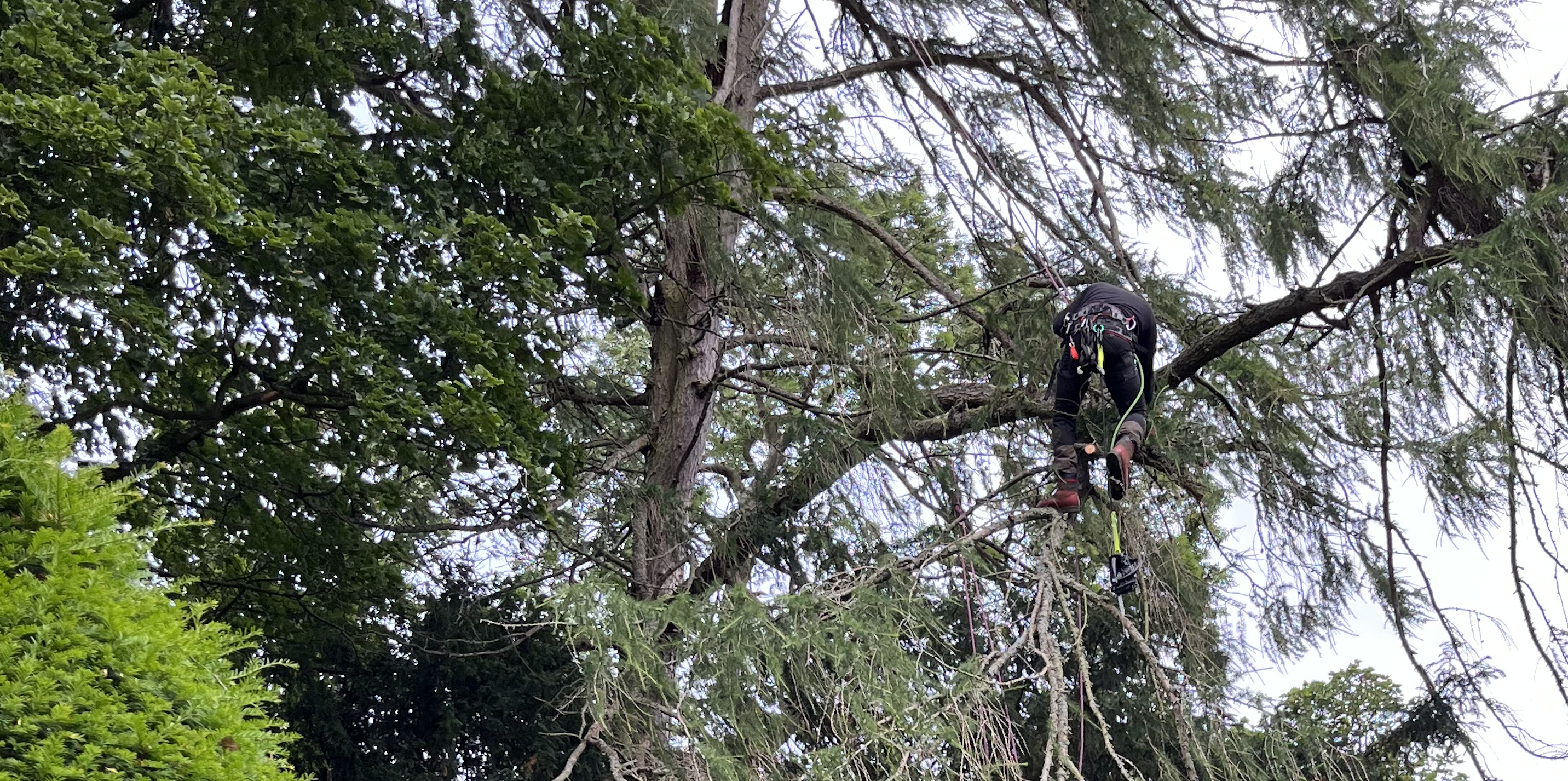
What park tree work usually covers
- Limbs over sited units
- Clearance above statics, lodges and decking, cut in sections and lowered. Deadwood over an occupied pitch comes first. See deadwood removal.
- Pitch-edge trees
- Crown lifting to get canopy off roofs, aerials and lighting, reduction where a tree has outgrown its pitch, removal where nothing else works. See crown lifting.
- Screening and shelter belts
- The conifer and poplar belts screening a park from a road, thinned or reduced in stages so the screen survives it. See vegetation management.
- Out-of-season storm response
- Windthrow and hung-up limbs made safe while the park is unstaffed. See emergency tree work.
- A record indexed by pitch
- What was inspected, what was done and when it’s next due, written against pitch numbers.
The closed season runs everything else
How short the window really is
Most parks here hold a planning or site licence condition that closes the park for part of the winter. What that leaves can be a few weeks between the last unit going home and the first arrival, and every trade wants the same weeks: roadways, electrical testing, decking. Tree work has to be booked early because it needs a large exclusion zone with nobody else standing in it.
Winter ground against heavy machines
The only window you can work in is the window the ground can least take. Grass pitches and verges in January rut under a tracked platform or a loaded tipper, and a rutted pitch is a defect you then repair before opening. So the method leans on climbing, ground protection where a machine is unavoidable, and the tarmac park roads as the working platform.
Nesting season starts as the window ends
The far end of the window runs into nesting season. The Wildlife and Countryside Act 1981 makes it an offence to damage or destroy an active nest while it is in use or being built, and hedges and conifer screens on a park are exactly where those nests are. Work planned late in the window gets a nest check first, and we’ll tell you if a section has to wait.
Working above and between sited units
A caravan roof isn’t a house roof
A limb that would knock a tile off a house goes through a static roof and into the room below. Units sit close together too: the separation your licence conditions require between caravans is a fire gap, not an access route, and it won’t take a machine or a controlled drop. So limbs come down on ropes to a landing area on the park road. There’s more to miss than the roof — gas bottle store, hook-up bollard, plastic gutters, satellite dish, flue, decking, hot tub.
Statics, tourers and tents aren’t the same target
A sited static can’t be moved, so the tree has to change. A touring caravan or motorhome can be moved, so the booking sheet solves it for a day. A tent offers no protection at all, which makes a limb over a camping field a different order of risk. We zone a park by what sits underneath and how often it’s occupied, not by the tree, as set out on tree safety inspections.
Pitch-fee holders have a view on their tree
Where owners hold pitches, the tree beside a static is often why that pitch was chosen. Tell us where that applies and we’ll price the option that keeps the tree if a sound one exists, rather than leave you showing the owner a stump.
Working while part of the park is occupied
Closed rarely means empty. Owners arrive to check units, keyholders turn up unannounced, and some parks keep a longer season on part of the park. We plan on the basis that somebody will walk down that road while a saw is running: exclusion zone across the park road with a signed diversion, a banksman where the loop is single track, chipping away from units, and the pitch numbers we’re on given to reception each morning. Park roads are usually a narrow one-way circuit, so vehicle positions are agreed before we arrive.
What your insurer and broker ask to see
Operators tell us the questions are the same every renewal, and again after any claim: when were the trees last inspected, by whom, what were they qualified to do, and what happened to the findings. A limb through a roof is a claim either way. What changes is whether you can produce a dated record showing a competent person looked at that tree and the recommendation was carried out or programmed.
So the record is written to be handed over, not filed: date, inspector, qualification, pitch numbers, findings, actions, next due date. For your contractor file we can evidence NPTC and LANTRA qualifications, Constructionline Gold certification and £10M public liability cover. The rest of the documentation set is on commercial tree surgery; where the stock needs a formal schedule instead, see tree surveys.
Protected trees on a park
Screening belts attract Tree Preservation Orders, because the screen is often the planning reason the park was permitted at all. Some parks also sit in a conservation area, where work needs a section 211 notice and a six-week period before anything starts. Six weeks is longer than most closed seasons, so paperwork begun in autumn is what makes January work possible.
What drives the price on a park
We quote per park after a walkover. What moves the number is how many pitches come out of service and for how long, whether the work is reachable from a park road or needs ground protection, how tight the window is, and how far arisings travel to the chipper. Splitting a large programme across two closed seasons is usually cheaper than compressing it into one.
What this doesn’t include
We don’t carry out pitch levelling, roadway or drainage repair, groundworks, fencing or unit repairs. Ecology and formal arboricultural surveys are separate. Stump grinding is quoted separately where a pitch returns to use — see stump grinding. Japanese knotweed we identify and can clear mechanically; treatment goes to a licensed specialist. Recurring visits sit under commercial tree maintenance.
Commercial cover. NPTC and LANTRA qualified. Constructionline Gold certified. £10M public liability insurance. Site-specific RAMS and a written record indexed by pitch.
What customers ask
Common questions
Do you have to work in the closed season?
Not always. Work over sited units and along pitch rows is usually easier with the pitches empty. Boundary belts, car parks and areas away from occupied pitches can often be worked on in season with an agreed exclusion area.
Can you work with a static still on the pitch?
Yes, where the tree allows it. Limbs are cut small and lowered on ropes rather than dropped, and the unit can be sheeted. If the loading can’t be controlled to that standard we’ll say the unit needs moving rather than take the risk with your stock.
What record do you leave for our insurer?
A dated record giving the pitches or areas covered, who inspected them and their qualifications, what was found, what was done, what remains and when the next visit is due. It’s written as an audit trail for a broker or claim, not as a formal tree survey.
Our screening belt is protected. Can it be reduced?
Often yes, by the correct route. A Tree Preservation Order needs a consent application. A conservation area needs a section 211 notice with a six-week period before work starts. Start that in autumn if you want the work done in the closed season.
Can you respond to storm damage while the park is shut?
Yes. Send photographs and the pitch numbers if it’s safe to take them, and tell us the gate code and access route. We prioritise by what is under the tree and what is holding it, then make safe first and clear afterwards.
Book your closed-season window
Send the pitch plan with the problem pitches marked, your season dates and where a chipper and tipper can stand. We’ll walk the park and quote in writing.