
Tree Surgery for Farms and Estates
Hedgerow, shelterbelt and veteran tree work for farms and estates across County Durham and North Yorkshire. We work to the farmland rules, not garden ones.
Send the location, the fields or tracks involved, your harvest and drilling dates and whether stock is in. We’ll walk it and quote the work in writing.
What our customers say
“I was recommended Ross to cut down and trim a large conifer hedge.”
“He came out quickly after getting in contact to assess what needed doing and provide a quote.”
“Very professional and educated me what was the best way to do the job.”
“He was quick, efficient and did a great job of clearing away.”
“Will definitely be using again and recommending to others.”
- NPTC qualified
- LANTRA qualified
- £10M public liability insurance
- Constructionline Gold certified
- RAMS as standard
Tree and hedgerow work on farms and estates
Farm tree work isn’t garden tree work at a larger scale. The rules differ, the calendar differs, and the arisings are usually worth keeping. We work for farms, mixed holdings, let farms and estates across County Durham, North Yorkshire and the Tees Valley.
Send the location, the fields or tracks involved, your harvest dates and whether stock is in. We walk it, agree the working window and quote in writing. General commercial paperwork sits on our commercial tree surgery page.
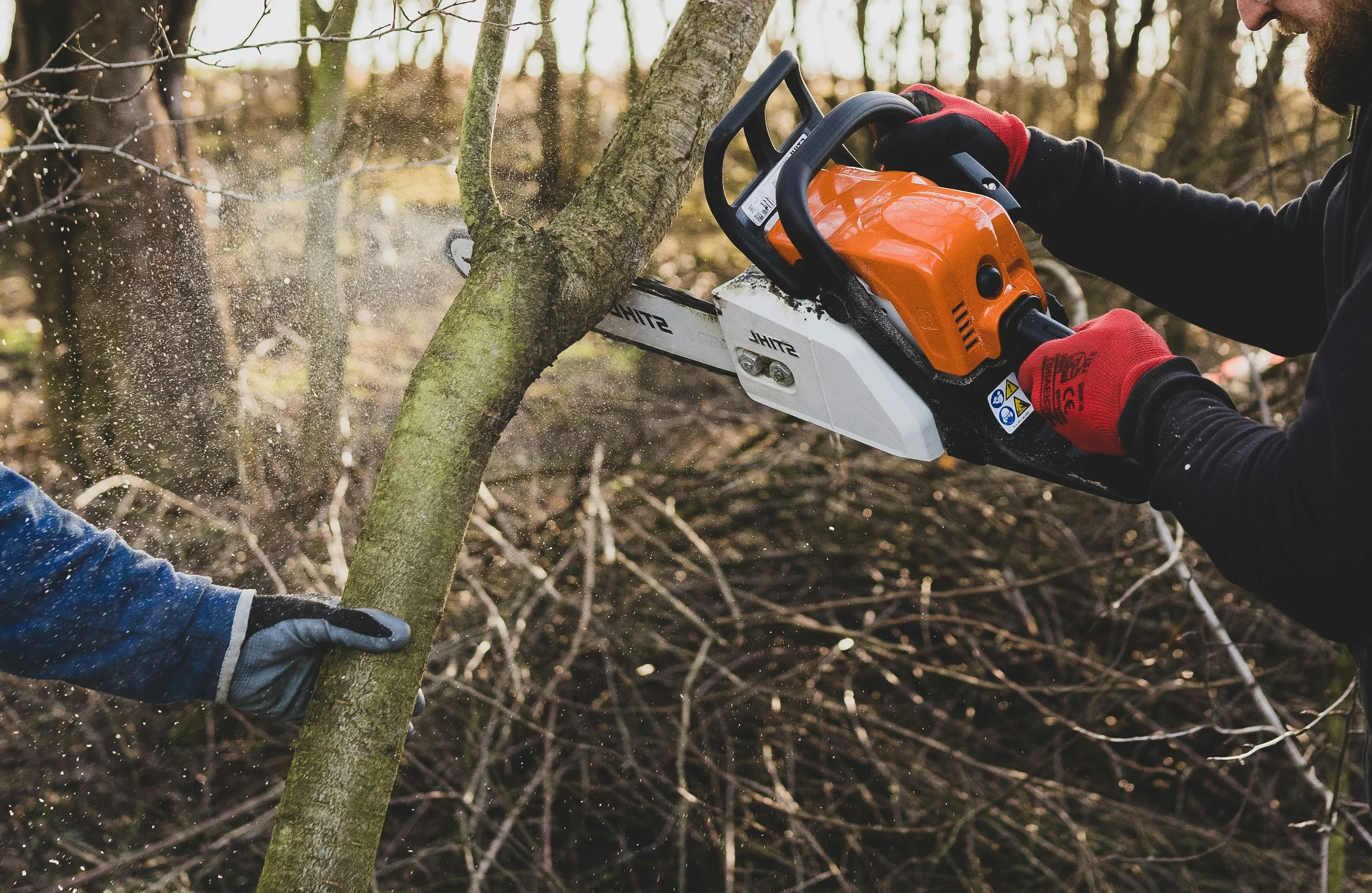
What we take on across a holding
- Hedgerow management
- Side-cutting, laying, coppicing, gapping up, and reinstating a flailed hedge.
- Shelterbelts and windbreaks
- Staged thinning, respacing, gap replanting and taking down failed belts.
- Hedgerow, parkland and veteran trees
- Deadwood, retrenchment pruning, halo thinning and monolithing. See tree pruning.
- Access and infrastructure
- Clearance over tracks, gateways and ditches, and removal over buildings. See tree removal.
The hedgerow rules that apply to farmland and not to gardens
The 1 March to 31 August cutting restriction
On agricultural land in England you can’t cut or trim a hedgerow between 1 March and 31 August. The restriction now sits in the Management of Hedgerows (England) Regulations 2024, with the 2 metre buffer from the hedge centre that must stay uncultivated and unsprayed. The exceptions are narrow: young hedges, laying and coppicing, highway visibility, and derogations tied to sowing. We confirm which applies before booking.
Removing a hedgerow is a separate question
The Hedgerows Regulations 1997 cover hedgerows on or adjoining agricultural land, common land and certain protected sites, running 20 metres or more, or shorter but meeting another hedgerow at each end. Removal starts with a hedgerow removal notice to the local planning authority. If the hedge is assessed as important, which begins at 30 years old plus wildlife, landscape or historical features, a retention notice keeps it.
Why the garden hedge advice doesn’t apply here
Most published advice gets this wrong. The hedgerow management rules and the March to August restriction are agricultural-land rules. They don’t govern a garden boundary, and the 1997 Regulations expressly exclude a hedgerow within, or marking the boundary of, the curtilage of a dwelling house. A garden hedge can lawfully be cut at any time of year provided there’s no active nest: the statute that bites there’s the Wildlife and Countryside Act 1981, which protects nests in use all year, in both settings. So a farmhouse garden hedge and the field hedge 30 metres away sit under different regimes. See domestic hedge cutting rules.
Shelterbelts and windbreaks
A shelterbelt works by being permeable, not solid. A belt letting roughly half the wind through slows it a long way downwind, while a solid one makes the wind jump it and drop back as turbulence just behind, which is worse than no belt over a lambing field. Most belts we see are single-age conifer, planted close and never thinned, so the inside stems have no taper and no low live branches. Open one in a single operation and the next south-westerly takes the lot. Thinning is staged: work from the leeward side, leave the windward row, return after a couple of winters.
Hedgerow, parkland and veteran trees
An old field oak isn’t managed like a street tree. You’re keeping it alive, not making it neat, and the low branches and deadwood are much of the value. Where a crown is retrenching we work with it, shortening outer limbs in small steps across years.
Most of the damage is at ground level
What kills these trees is the ground, not the crown. Stock stand under the only shade in the field, poach the soil, rub the bark and dung over roots that run well past the crown spread. A generous stock fence does more for a veteran than any pruning, and a new track or trench inside that area does more harm than a heavy limb.
Tracks, gateways and machinery clearance
Clearance here is measured against the tallest and widest thing that must get through, not a footpath standard. A loaded straw trailer, a telehandler with the boom part raised, a combine on a low loader and a folded sprayer are four different envelopes, and the deciding one is often used twice a year. A hedge grown out on a blind field exit belongs on the risk register, and a branch near an overhead line goes to the network operator rather than to us.
Timber, woodfuel and the volume you can fell
Felling licences
A Forestry Commission felling licence is needed to fell more than 5 cubic metres in a calendar quarter, and no more than 2 of those may be sold. Exemptions cover garden, orchard and churchyard trees and small stems, but a woodland block or a long belt passes the threshold quickly, and a licence takes time.
Keeping the timber
On most holdings the arisings are the point. We can cord and stack to length where you nominate, ring and split, or chip to a heap for bedding, tracks or biomass. Say which at quote stage: stacking where the loader can reach in February matters more than it sounds. Wood sold in small volumes in England must meet the Ready to Burn moisture requirements; burning your own crop need not.
Ditches, banks and where the boundary actually runs
A watercourse along or through the holding makes you a riparian owner, and clearing an obstruction from the channel falls to you, including the alder off your own bank.
One old presumption is worth knowing before an argument starts. Where a hedge and a ditch run together on a boundary, the law presumes the ditch was dug on the owner's side of the line, with the spoil thrown back to form the bank the hedge grows on. Both are therefore presumed to belong to the hedge owner, and the boundary is the far edge of the ditch.
Stock, standing crops and the working window
Stock out of the working field or a temporary fence up, gates left as found, and every arising off the ground before the field goes back into use. Ground pressure on wet grassland and where the chipper stands are agreed on the walkover.
Clippings that poison livestock
Yew clippings are lethal to cattle and horses and stay lethal after they wilt, and wilted cherry and laurel are dangerous for the same reason. Acorns and oak leaves poison cattle in quantity, and sycamore seeds and seedlings cause atypical myopathy in horses. A heap of trimmings pitched over a fence into a grazing field is one of very few situations where tree work itself can kill stock, so where arisings go is agreed before we cut.
What drives the price on a farm or estate
We quote per job after a walkover. The drivers are hedge length and height and how far it has gone past a flail; tree numbers, size and condition; ground conditions and time of year; whether timber is processed on site or removed; and how tight the window is between harvest and the March closed season.
What isn’t included
We don’t offer tractor flail hedge cutting, fencing, machine ditching or stock handling. Woodland plans, licence applications and ecology surveys aren’t part of a tree work quote. Stump grinding is quoted separately: see stump grinding. For a documented inspection cycle see commercial tree maintenance.
Commercial cover. NPTC and LANTRA qualified. Constructionline Gold certified. £10M public liability insurance. Site-specific RAMS and written completion reporting.
What customers ask
Common questions
Can you cut a farm hedge in the summer?
Not normally. On agricultural land in England, cutting or trimming a hedgerow between 1 March and 31 August is restricted. The exceptions are specific and narrow, and we confirm which one applies before booking rather than assume one does.
Does the closed season apply to the farmhouse garden hedge?
No. The farmland hedgerow rules don’t govern a garden boundary. A garden hedge can be cut at any time of year provided there’s no active nest, and nest protection under the Wildlife and Countryside Act 1981 applies all year round in both settings.
Do I need a felling licence to fell trees on my own land?
A Forestry Commission felling licence is needed to fell more than 5 cubic metres in a calendar quarter, of which no more than 2 cubic metres may be sold. Exemptions cover garden trees, small-diameter stems and genuinely dangerous trees. We raise it at the walkover because a licence takes time.
Can we keep the timber and the chip?
Yes, and most holdings do. Tell us at quote stage whether you want cord stacked to length, rings split, or chip heaped for bedding, tracks or biomass. It changes the method and the cost, so it needs deciding before the work rather than during it.
Will you work in a field with stock in it?
Only with stock moved out or a temporary fence in place, and with arisings cleared before the field goes back into use. Yew and wilted cherry are lethal to cattle and horses, and acorns and sycamore seed carry their own risks, so where cuttings go is agreed before cutting starts.
Talk to us about the holding
Send the location, the fields or tracks involved, your harvest and drilling dates and whether stock is in. We’ll walk it and quote the work in writing.