
Tree Surgery for Schools
School tree work scoped in the spring term and delivered in the summer holidays. Playground and boundary tree risk across County Durham and North Yorkshire.
Send the site plan or a marked aerial image, the trees that concern you, any existing survey and your summer shutdown dates. We’ll assess and specify in time for the holidays.
What our customers say
“I was recommended Ross to cut down and trim a large conifer hedge.”
“He came out quickly after getting in contact to assess what needed doing and provide a quote.”
“Very professional and educated me what was the best way to do the job.”
“He was quick, efficient and did a great job of clearing away.”
“Will definitely be using again and recommending to others.”
- NPTC qualified
- LANTRA qualified
- £10M public liability insurance
- Constructionline Gold certified
- RAMS as standard
Tree surgery for schools, scoped in spring and delivered in the holidays
School tree work runs on the school year, not on the tree surgeon's diary. The trees over your playground, paths and boundary need looking at in the spring term, so the work can be specified, approved, ordered and then delivered in July and August while the site is empty. We do that for maintained schools, academies and multi-academy trusts across County Durham and North Yorkshire.
Send the site plan or a marked aerial image, the tree positions that concern you, any existing survey and your shutdown dates. If a tree is already unsafe, that doesn’t wait for August.
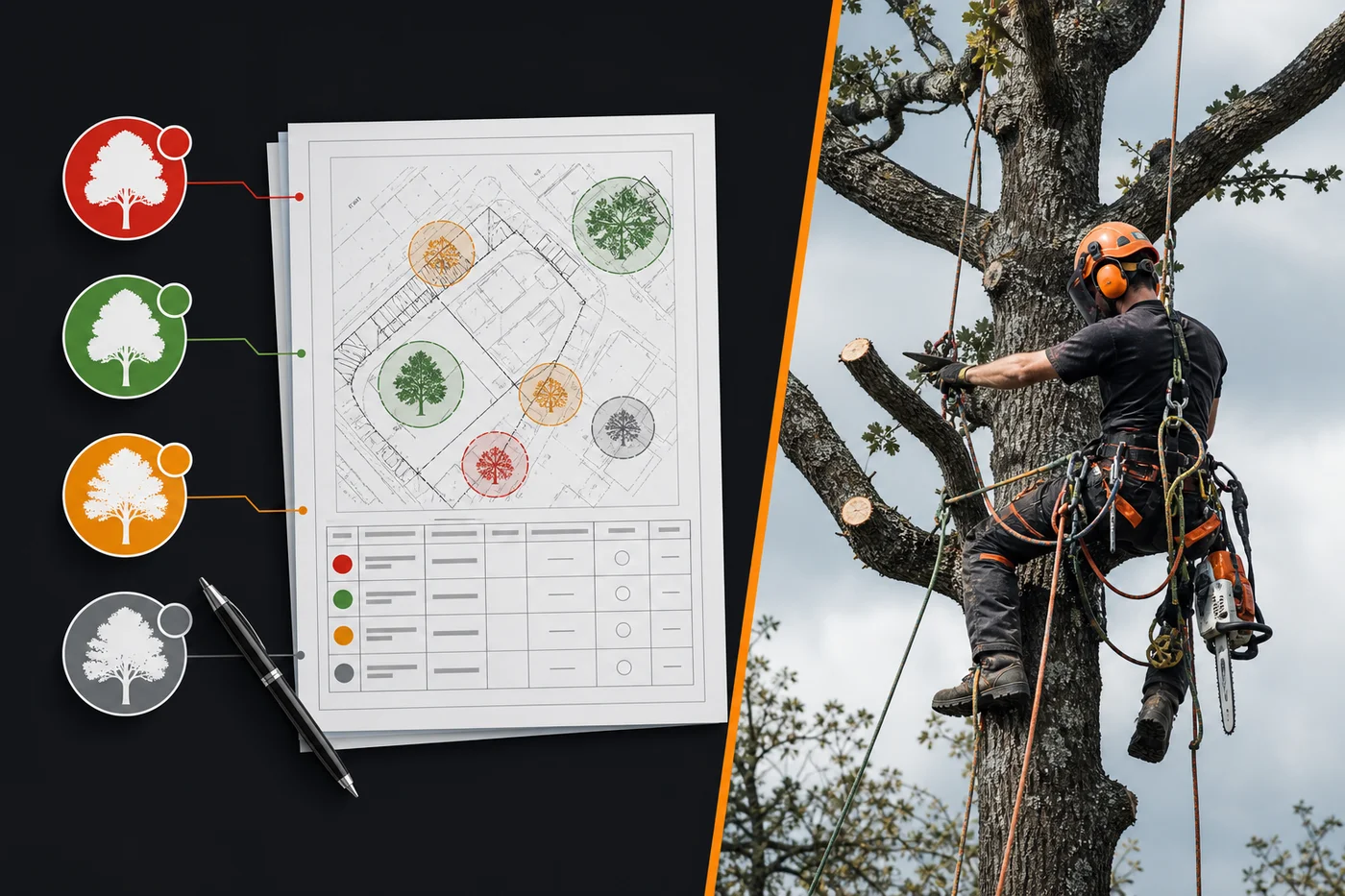
Why the survey happens in spring and the work happens in August
What the spring visit is actually for
Two reasons, and only one is administrative. The practical one is that a tree can only be read properly in leaf. You can’t grade an ash in February. Whether it has flushed, how much crown has come back and whether the decline is advancing are late-spring judgements, and ash dieback is the largest single driver of school tree removals in this region. See ash dieback removal. The administrative reason is that a specification written in April can clear an approval cycle and a purchase order in time for the holidays. One written in June can’t.
The six weeks everybody else wants
The summer holiday isn’t just your tree window. It’s the roofer's, the flooring contractor's and the decorator's, and they all want the same gate, the same compound and the same site manager. A chipper and a scaffold lorry can’t share one yard, so book early and tell us who else is on site that week. October half-term and Easter suit smaller jobs.
What we carry out on school sites
- Playground and path tree work
- Deadwood removal, crown lifting over paths and play equipment, and reduction where a crown has grown over a boundary or a building.
- Removals, with the gap thought about
- Dismantling where a tree can’t be retained, and a replacement position discussed rather than left as an empty corner. See tree removal.
- Boundary hedges and field margins
- Hedge cutting, staged reduction, field boundary clearance and sightlines at gates and crossings.
- Inspection cycles and records
- An annual walkover with a written record your site manager and insurer can use. See tree safety inspections.
The trees that set the priority
Play equipment, paths and the trim trail
Priority is set by what is underneath, not by which tree looks worst. A dead limb over a fixed play frame, a wet-pour surface or a trim trail is a different order of problem from the same limb over the far corner of the field, because several hundred children pass beneath one of them twice a day and nobody stands under the other. A low, climbable first fork on an accessible tree is a decision the school takes deliberately, and crown lifting to remove that limb is one of the most common things we’re asked for. Yew and laburnum come up regularly, and removal isn’t automatically the answer: fencing the base or moving the route can each be right, and that’s the school's risk assessment to make.
What a Category U grade does and doesn’t tell you
A BS5837 survey supports development planning; its retention categories are not safety ratings. A tree beside a play area may need different action from one at the edge of a field, even if they share a category. If you only hold a planning survey, we can discuss whether a separate condition assessment is needed. See BS5837 tree categories.
Forest school areas need the opposite specification
A school with a forest school area doesn’t want it tidied. Standing deadwood, habitat piles, low branches to duck under and coppice material for den building are the point of the space, and a crew told to make it safe will strip out what the teaching depends on. Say so at the survey. The approach that works is to manage the targets rather than the trees: keep the high-risk retentions away from where the children sit, and keep the chip on site.
Boundary trees and hedge complaints
Most school tree complaints arrive from over the fence: overhang, shade, leaves in gutters, and a hedge that has gone up rather than out.
When the neighbour complains about the school's hedge
The High Hedges provisions in Part 8 of the Anti-social Behaviour Act 2003 apply in England and Wales, and run on a complaint from a domestic property about a line of two or more mostly evergreen trees or shrubs over two metres acting as a barrier to light or access. A householder next to the school can use that route against a hedge on school land. A school looking the other way at a neighbour's leylandii generally can’t, because the school isn’t a domestic property. Where a complaint does succeed, the limits matter as much as the power: a remedial notice cannot require the hedge to be reduced below two metres, and cannot require it to be removed. The outcome is a managed height, which means a cutting cycle. See domestic hedge cutting rules.
DBS, safeguarding and what we hold
We’ll be straight about this, because schools ask. Schools normally require evidence of enhanced DBS checks for contractors attending during the school day where there’s any prospect of unsupervised contact with pupils. Ross Webster is NPTC and LANTRA qualified, Constructionline Gold certified and carries £10M public liability insurance. He isn’t DBS checked.
So we programme school tree work for the holidays or outside school hours, when pupils are off site, which is how most school tree work is delivered anyway. Where a school wants term-time work, the arrangements for a contractor without a DBS check are the school's to set rather than ours to assume: signing in, escorted access, supervision and segregation from pupils. If your trust requires a DBS check for any contractor on site regardless, tell us at the enquiry rather than after the order. Two things we do unasked: we photograph trees and never pupils, and exclusion zones get fenced rather than taped, because tape and cones read as an invitation to a child.
Who actually buys school tree work
It varies more than people expect, and it changes who the quote goes to. A maintained school may buy through the local authority or out of its delegated site budget. An academy is its own legal entity, and in a multi-academy trust the estates function is often held centrally, which means one specification across several schools and one approval point rather than a headteacher's decision. A voluntary-aided church school will usually have a diocesan board involved in anything touching the land. Most trusts set a written threshold above which multiple quotes or a formal tender are required, so tell us the threshold. Tree work is normally revenue, out of the site maintenance budget, and that’s tight by the spring term.
Telling parents and neighbours first
A mature tree coming off a school field will be discussed locally whether or not the school speaks first. Notify parents and adjoining neighbours before the work, and give them the reason rather than the fact. We’ll provide a plain-English summary of the condition findings for the school to publish, because "the tree surgeon said it had to come down" doesn’t survive a parents' group.
What drives the price on a school site
We quote per site after an assessment. Tree size, species and condition set the baseline. What moves the figure on a school is everything around it: access through a single gate, whether machinery can cross a playing field without rutting a pitch the groundsman has just renovated, whether arisings have to be carried across a hard play surface, and how much of the work must fit inside a fixed six-week window. See commercial tree surgery, or commercial tree maintenance for a recurring cycle.
What isn’t included
Play equipment inspection, surfacing repair, fencing, groundworks, pitch reinstatement, ecology surveys and BS5837 planning surveys aren’t included. Stump grinding is quoted separately and is normally programmed into the same holiday visit, because a ground stump on a play area can’t be left open for a term. See stump grinding and tree surveys.
Commercial cover. NPTC and LANTRA qualified. Constructionline Gold certified. £10M public liability insurance. Site-specific RAMS, written completion reporting, and work programmed for the holidays or outside school hours as standard.
What customers ask
Common questions
When should we book school tree work?
Ask for the survey in the spring term and the work in the summer holidays. Spring is when a tree can actually be assessed in leaf, ash especially, and it leaves enough time for the specification to clear an approval cycle and a purchase order before July. Summer slots fill early, because every other contractor wants the same six weeks.
Are you DBS checked?
No. Ross Webster is NPTC and LANTRA qualified, Constructionline Gold certified and carries £10M public liability insurance, and we won’t claim a check we don’t hold. School tree work is programmed for the holidays or outside school hours when pupils are off site, which is how most of it’s delivered anyway. If your trust requires a DBS check for any contractor on site regardless, tell us at the enquiry stage.
Can you work during term time?
Sometimes, and it depends on the school rather than on us. Because we aren’t DBS checked, the arrangements for term-time attendance are the school's to set: signing in, escorted access, supervision and full segregation from pupils. Exclusion zones are fenced rather than taped on a school site, and noise and access usually push the work outside teaching hours in any case.
Our survey lists a Category U tree. Does it have to come down now?
Not automatically. A BS5837 category describes retention value for a development, not danger. What sets the urgency is what sits beneath the tree. A U-rated tree over play equipment or a main path is a priority. The same grade in a hedge line at the bottom of the field may sit on a monitoring cycle. If the planning survey is the only tree record the school holds, a separate safety inspection is the missing piece.
A neighbour has complained about our boundary hedge. What can the council require?
The High Hedges provisions in Part 8 of the Anti-social Behaviour Act 2003 apply in England and Wales and let a householder complain about an evergreen hedge over two metres on school land. If a remedial notice is issued, it cannot require the hedge to be reduced below two metres and it cannot require the hedge to be removed. In practice the outcome is a managed height, so the sensible response is a cutting cycle rather than a removal.
Book a spring survey for summer work
Send the site plan or a marked aerial image, the trees that concern you, any existing survey and your summer shutdown dates. We’ll assess and specify in time for the holidays.