
Shrub Removal
Shrub, bush and woody growth removal across County Durham and North Yorkshire. Cutting back or grubbing out, roots handled, and the ground left workable.
Send the length or area, roughly how tall it’s, the plants if you know them, the access width and what you want the space to be afterwards. We’ll confirm whether it needs cutting back or taking out.
What our customers say
“I was recommended Ross to cut down and trim a large conifer hedge.”
“He came out quickly after getting in contact to assess what needed doing and provide a quote.”
“Very professional and educated me what was the best way to do the job.”
“He was quick, efficient and did a great job of clearing away.”
“Will definitely be using again and recommending to others.”
- NPTC qualified
- LANTRA qualified
- £10M public liability insurance
- BS3998 standard
Shrub, bush and woody growth removal
Shrub removal is the work that sits between hedge trimming and tree felling. Laurel that has become a wall. An overgrown rhododendron nobody can see past. Elder and buddleia pushing out of a boundary. A border of woody growth now taller than the fence it was planted behind. Some of it can be cut back and kept. Some of it has to come out, roots and all.
Tell us the length or area, roughly how tall it stands, what the plants are if you know, and what you want the space to be afterwards. Bare soil for replanting, turf, a clean fence line and a hard surface are four different jobs. Photos and the access width are usually enough to start the conversation.
What shrub removal includes
- Cutting back
- Height and spread reduced on shrubs that are staying, cutting to growth that will break rather than into bare wood that won’t.
- Cutting down to ground level
- Woody growth taken off at or just below ground level, where the stump can be left to decay or ground out later.
- Grubbing out
- The whole plant lifted with its root plate so it can’t regrow. By hand on smaller shrubs, by machine where the root system and the access allow it.
- Stumps and roots
- Larger shrub stumps ground out where services and access permit. See stump grinding.
- The ground afterwards
- Holes backfilled, the surface raked level, and arisings chipped or taken away as the written scope states.
Cutting back or grubbing out
When cutting back is enough
If a shrub is healthy, in the right place and simply too big, reduction is usually the better answer and the cheaper one. Yew, box, holly, laurel, privet and hawthorn all break from old wood, so a hard reduction on those recovers. Spread that work over two seasons on a badly overgrown shrub, taking one side or one third at a time, and it comes back faster and looks right sooner.
When cutting back won’t work
Some shrubs don’t come back from bare wood at all. Conifers, including leylandii, cypress and juniper, carry no dormant buds on brown wood, so a cut behind the green leaves leaves a permanent bare face. If a shrub has already been cut into that wood, or it’s dead, dying, badly placed or lifting a wall or path, removal is the honest recommendation rather than another trim.
What the roots do if you leave them
Cutting to ground level isn’t the end of the plant for every species. Cherry laurel, elder, lilac, snowberry and sumach all send suckers up from a cut stump or a severed root, sometimes several feet from where the plant stood. Others, box and most conifers among them, won’t regrow once the stem is cut. Which group your plants fall into decides whether the stump has to come out or can safely be left.
The ground after the shrubs come out
Roots against walls, paths and drains
A mature shrub on a boundary usually has roots under that boundary. Pulling a root plate out beside a wall, a paving edge, a drain run or a fence post can take the structure with it, so on those we cut, grind or dig by hand rather than pull. Where a root has already lifted a slab or opened a joint, we point it out before starting rather than after.
Soil, levels and replanting
Grubbing out leaves holes and a loose, uneven surface. We backfill and rake level, which leaves the area ready for planting or turf. Be aware that soil under a long-established evergreen is usually dry and poor, and worth improving before you plant into it. Woodchip can be left for mulch if you want it.
Nesting birds, height and the law
Shrubs are prime nesting habitat, and an active nest stops the work. Wild birds, their nests and their eggs are protected under the Wildlife and Countryside Act 1981 while a nest is in use or being built, so we check before cutting and we postpone rather than work around one. Outside that, a garden shrub or hedge can lawfully be cut at any time of year. The cutting dates people quote at each other apply to hedgerows on agricultural land, not to garden boundaries, and our domestic hedge cutting rules guide sets out the difference.
Two other things can apply. If your shrubs form a line of two or more mostly evergreen plants over two metres that acts as a barrier to a neighbour's light or access, they fall within the High Hedges provisions of Part 8 of the Anti-social Behaviour Act 2003, which covers England and Wales. A remedial notice under those provisions cannot require the height to be taken below two metres and cannot require the hedge to be removed, so a complaint is a reduction route, not a removal route. Separately, a large old shrub in a conservation area may count as a tree: the test there’s the diameter of the stem, not the word you use for the plant. We check both before quoting.
Where shrub work becomes clearance
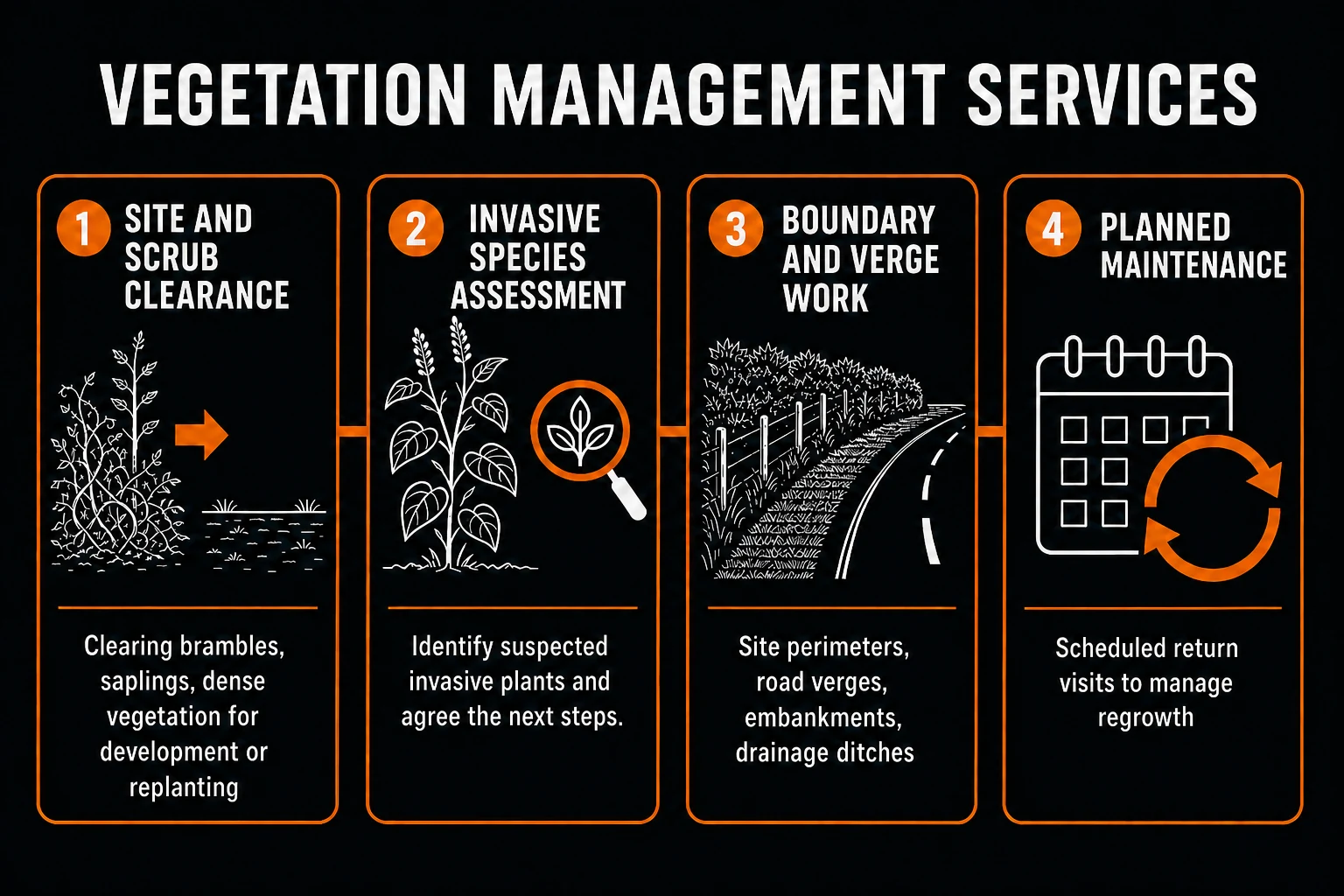
There’s no hard line, so we use volume and purpose. A few shrubs and a fence line is shrub removal. A garden lost to bramble, scrub and self-seeded saplings is vegetation management. A plot being cleared ahead of a build, with programme dates, RAMS and a site contact, is site clearance. If the plants are a maintained boundary you intend to keep, the work belongs with hedge care, and if a shrub has quietly become a tree, see tree removal and tree felling.
What drives the price
We quote per job after a site assessment. The drivers are the number and size of plants, the species and whether it suckers, the depth and spread of the root systems, whether the job is a cut-back or a full grub-out, how close the plants sit to walls, fences, paths and buried services, the access width for a machine or a barrow, and the volume of waste. That last one surprises people. Dense evergreen shrubs produce far more material per metre than their footprint suggests, and waste volume is often the largest single item on a shrub job.
What isn’t included
Shrub removal covers the plants and the agreed clearance. Turfing, paving, fencing, groundworks and soil import aren’t included. Japanese knotweed treatment isn’t work we carry out: we can identify suspected knotweed and clear other vegetation around it, but treatment and disposal go to a licensed specialist. Tree removal, stump grinding and hedge trimming are services we also provide, quoted separately. See tree removal, stump grinding and hedge care.
Qualifications and cover. NPTC qualified. LANTRA qualified. £10M public liability insurance. Nesting-bird checks and a written scope before work begins.
What customers ask
Common questions
Will a shrub grow back if you cut it to ground level?
It depends on the species. Cherry laurel, elder, lilac, snowberry and sumach sucker from a cut stump or a severed root and will come back, sometimes some distance away. Box and most conifers won’t regrow once the stem is cut. We tell you which group your plants are in so you can decide whether the stump needs to come out.
Can leylandii or another conifer be cut back hard instead of removed?
Only within the green growth. Conifers carry no dormant buds on brown wood, so a cut behind the foliage leaves a bare face that stays bare. If the shrub has already been cut into that wood, reduction won’t fix the look and removal is usually the sensible answer.
Do you dig the roots out?
Where the job needs it and the site allows it. Smaller shrubs are grubbed out by hand. Larger root plates are dug or ground out where access and buried services permit. Next to a wall, a path, a fence post or a drain run we cut and grind rather than pull, because pulling a root plate can take the structure with it.
Can you take out shrubs growing against a fence or wall?
Yes, with a look at the structure first. We check what the roots are under and how sound the wall or fence is before deciding whether to grub out, grind or cut low and treat the regrowth. Anything already lifted or cracked gets pointed out before work starts.
How much does shrub removal cost?
We quote per job after a site assessment. The number and size of plants, the species, root depth, whether it’s a cut-back or a full grub-out, proximity to walls and services, access width and waste volume all affect it. Dense evergreens generate a lot more waste than their size suggests, and that often drives the price.
Shrubs taken over the border?
Send the length or area, roughly how tall it’s, the plants if you know them, the access width and what you want the space to be afterwards. We’ll confirm whether it needs cutting back or taking out.