
Tree Pruning in Durham
Tree pruning in Durham for reduction, thinning, lifting and deadwood. We check permission, access and timing before a written quote.
Send photos of the tree and its surroundings, then tell us what outcome you want. We’ll arrange an assessment and quote.
What our customers say
“I was recommended Ross to cut down and trim a large conifer hedge.”
“He came out quickly after getting in contact to assess what needed doing and provide a quote.”
“Very professional and educated me what was the best way to do the job.”
“He was quick, efficient and did a great job of clearing away.”
“Will definitely be using again and recommending to others.”
- NPTC qualified
- LANTRA qualified
- £10M public liability insurance
- BS3998 standard
Tree pruning in Durham
Tree pruning should solve a clear problem without leaving the tree weaker. We prune trees in Durham and County Durham to improve clearance, manage size, remove deadwood, improve structure or shape young growth. The method follows the species, condition and space around the tree.
Send photos and explain what you want to change. More light, less overhang, a better shape and safer clearance are different outcomes. We assess the tree before agreeing which branches should be removed and provide a written quote.
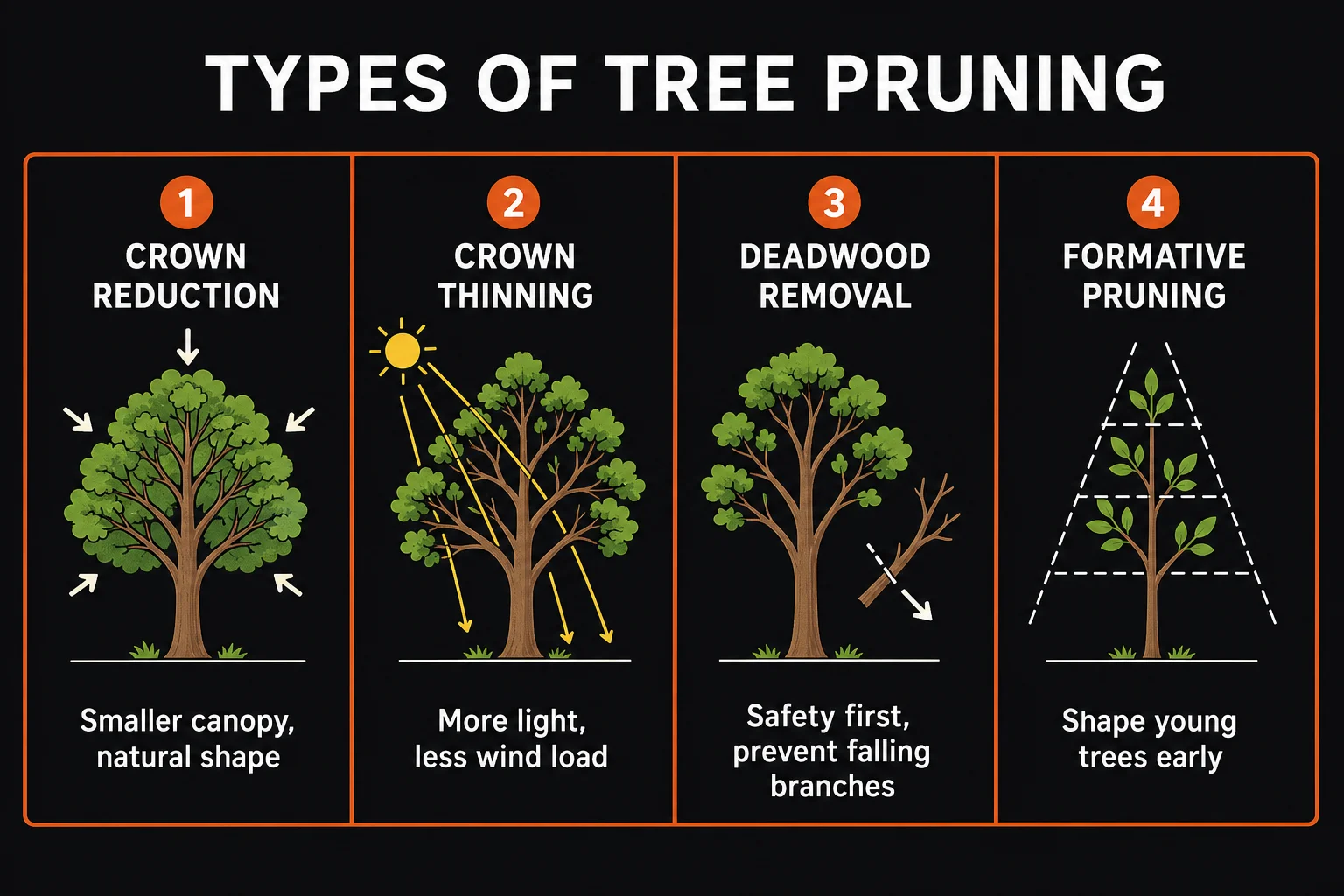
Pruning methods we use
- Crown reduction
- Shortening selected branches back to suitable laterals to reduce overall canopy size while retaining a natural shape.
- Crown thinning
- Removing selected branches to reduce density and improve light or air movement without stripping the canopy.
- Crown lifting
- Removing lower branches where clearance from a path, drive, roof or sightline is the agreed objective.
- Deadwood and formative pruning
- Removing dead or weakly attached wood, or guiding young growth into a stronger structure. Pollarding is considered only where the tree and previous management make it appropriate.
Timing, nests and tree health
Most deciduous pruning is planned in the dormant season, while cherry, plum, magnolia and walnut need different timing. Deadwood or an immediate hazard can require action outside the normal seasonal window. We check for active nests before work and postpone cutting if it would disturb protected birds.
We don’t top trees or leave stubs. Cuts are made to the agreed scope and the tree's condition. If dieback or decay means pruning wouldn’t solve the risk, we explain that before recommending removal.
What's not included
Pruning covers the pruning work itself. Hedge trimming and tree removal are services we also provide, quoted separately. See our hedge care and tree removal pages. Work on a protected tree without consent is outside pruning. Where a survey is needed first, we also provide arboricultural surveys. Stump grinding is a service we also provide, priced separately. See our stump grinding page. Traffic management is quoted separately where needed.
Permissions in Durham
A Tree Preservation Order or conservation-area status can restrict pruning. We check the address and proposed work before booking and explain whether consent or notice is required. Permission isn’t assumed simply because the work is called maintenance.
Access and safe working
Access for people and equipment affects the method and cost. We check gates, steps, slopes, fragile ground, buildings, boundaries, overhead lines, public paths and the area where branches will be lowered. An exclusion zone is established before cutting and agreed arisings are removed or retained as stated in the quote.
Tree pruning quote process and price
- Discuss the outcome. Tell us what needs changing and send photos if safe.
- Assess species and condition. We check structure, timing, permissions, access and surrounding targets.
- Agree the method. The written quote names the pruning type, scope, waste handling and any exclusions.
- Prune and clear. We carry out the agreed cuts and clear away the branches included in your quote.
Tree size, canopy height, access, condition, number of trees, waste and any traffic or specialist equipment affect the price. We quote per job rather than use a misleading one-size-fits-all rate.
Good cuts finish just outside the branch collar and back to a suitable bud or lateral branch. Late-winter timing suits many deciduous trees, but species and condition decide the safe window.
Pruning standards. NPTC and LANTRA qualified. £10M public liability insurance. BS3998 standard approach. Written quote before work begins.
What customers ask
Common questions
When should trees be pruned in Durham?
Most deciduous trees are assessed for dormant-season pruning. Cherry, plum, magnolia and walnut need different timing, and active nests must always be protected. We recommend timing after seeing the species and condition.
Do I need permission to prune a tree in Durham?
A Tree Preservation Order or conservation-area status may require consent or notice. We check the address and explain the route before work is booked.
What is the difference between reduction and thinning?
Reduction shortens the canopy to control size. Thinning selectively reduces density to improve light or air movement. We agree the outcome before choosing the method.
Can you prune a tree beside a house or path?
Yes, subject to the site assessment. Buildings, paths, boundaries and access affect the exclusion zone, lowering method and quote.
How much does tree pruning cost in Durham?
Tree size, height, condition, access, number of trees, waste and equipment affect the price. We provide a written quote after assessing the job.
Need a tree pruned in Durham?
Send photos of the tree and its surroundings, then tell us what outcome you want. We’ll arrange an assessment and quote.