
Tree Surgeon in Newton Aycliffe
Tree surgery in Newton Aycliffe, Aycliffe Village, Middridge, Woodham and School Aycliffe. Oversized estate trees assessed on site before a written quote.
Send the postcode, photos of the whole tree and its base, and tell us whether the working area is reached from the front or through the back. Access decides the method here.
What our customers say
“I was recommended Ross to cut down and trim a large conifer hedge.”
“He came out quickly after getting in contact to assess what needed doing and provide a quote.”
“Very professional and educated me what was the best way to do the job.”
“He was quick, efficient and did a great job of clearing away.”
“Will definitely be using again and recommending to others.”
- NPTC qualified
- LANTRA qualified
- £10M public liability insurance
- BS3998 standard
Tree surgery in Newton Aycliffe and Aycliffe Village
We carry out tree removal, pruning, stump grinding and hedge work for houses, landlords and managed properties in Newton Aycliffe and the villages around it. Most of what we’re called to here has one underlying cause: a tree that was the right size for the garden in 1965 and isn’t the right size for it now.
Send the postcode, photographs of the whole tree and its base, and tell us how the working area is reached. A site assessment then confirms condition, ownership, permissions, access and the written scope before anything is booked.
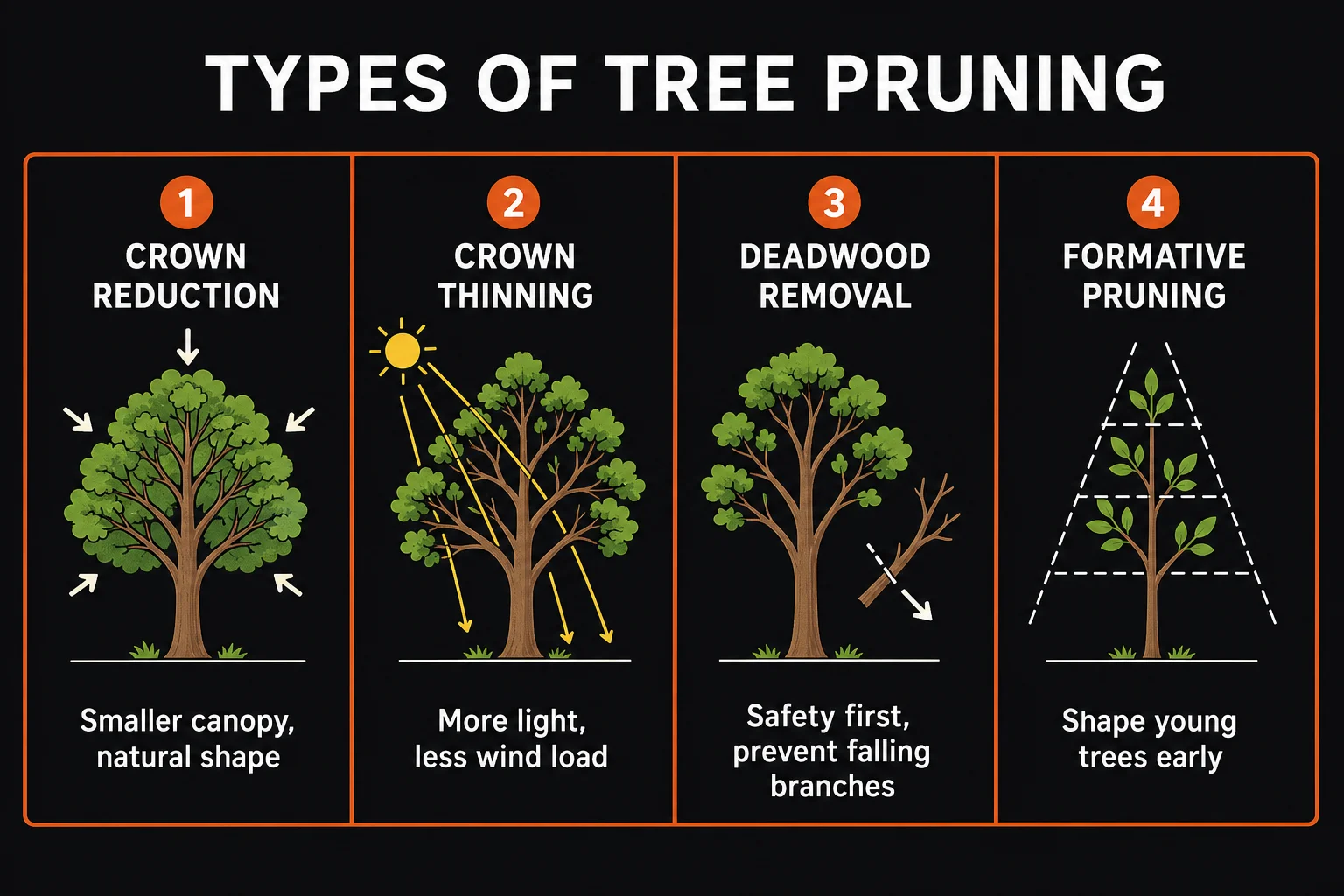
Work we carry out around Newton Aycliffe
- Tree removal and sectional dismantling
- Felling where there’s a genuine drop zone, and rope-and-rig dismantling where a house, garage, drive, footpath or fence sits inside falling distance. See tree removal.
- Pruning and deadwood
- Crown reduction, thinning, lifting for clearance over a drive or roof, and deadwood removal.
- Stump grinding
- Stumps ground below ground level where underground services and the ground allow.
- Hedges and conifer screens
- Hedge reductions, staged work on overgrown boundaries, and removal where a screen has stopped being a hedge. See hedge care.
A new town where the trees all reached size together
Newton Aycliffe was designated a new town in 1947 and built out over the three decades after. The planting went in with the houses: small nursery stock in small front gardens, verge trees along the estate roads, screening belts on the outer edges. Sixty and seventy years on it’s mature at more or less the same moment, which is why one street can need work at half a dozen properties in a single year. That isn’t neglect. It’s one planting scheme arriving at full size at once.
The species the estates were planted with, and when they can be cut
Ornamental cherry, birch, rowan, whitebeam, sycamore, Norway maple, lime and horse chestnut make up most of what we see across Cobblers Hall, Horndale, Simpasture, Woodham, Agnew, Byerley Park and Sugar Hill. Two of those bring a calendar with them. Cherry and the other Prunus are better pruned in summer, when wounds close quickly and the risk of silver leaf and bacterial canker is lowest, rather than in winter when people want the job doing. Sycamore and Norway maple bleed heavily if cut in late winter, so we would rather work them in full leaf. See when to prune trees.
Small plots, close houses, no drop zone
A 1950s semi with a six-metre front garden and a full-grown lime in it has nowhere for that tree to go, so the work becomes sectional dismantling on ropes over a drive, a path, a parked car and usually a neighbour's fence. The ground is heavy glacial clay and service runs are shallow, so root and drain complaints are common. Where the tree is worth keeping, a reduction repeated on a cycle often beats removal. See crown reduction.
Boundary poplars and leyland cypress screens
The estate-edge screening is where the disputes sit. Hybrid poplar was planted for quick height and is now tall, brittle and directly behind gardens; leyland cypress went in as hedging in the 1970s and 1980s and in places has been left to become a row of twelve-metre trees. Two things are worth knowing. The High Hedges provisions in Part 8 of the Anti-social Behaviour Act 2003 apply in England and Wales to a line of two or more mostly evergreen trees or shrubs over two metres acting as a barrier to light or access, and a remedial notice cannot require the hedge to be reduced below two metres and cannot require it to be removed. And a conifer row left for forty years won’t always take a hard reduction without going brown and staying brown, so the assessment has to be honest about whether reduction or removal is realistic. See conifer removal.
Whose tree is it: verge, amenity land or garden
This matters more here than in an older town. New town layouts put a great deal of tree stock on verges, greens and open amenity land between the houses, and that belongs to Durham County Council rather than the nearest household. If a tree turns out to sit on highway verge or council land, the request goes to the council and we’ll say so rather than take the job.
Aycliffe Village, School Aycliffe and the older stock
The old village to the south is a different job. Around the green and St Andrew's church the trees are older and larger, and some are genuinely old: churchyard yew, mature ash, sycamore and lime that predate the new town by centuries. Bigger sections, longer rigging, more care about what sits underneath, and a far higher chance of designation, because parts of the village fall inside a conservation area. We check that boundary against the actual address rather than assume it from the postcode. Out along the field boundaries towards Middridge and Woodham the hedgerow ash is largely affected by ash dieback, which only gets more dangerous to work the longer it’s left. See ash dieback removal.
Aycliffe Business Park
The business park north-west of the town, on the ground of the wartime Royal Ordnance factory, carries its own boundary belts, car park trees and screening planted with the units. That work is planned around shifts, deliveries and pedestrian routes and quoted with site-specific RAMS. See commercial tree surgery.
Protected trees and consent: Durham County Council
Newton Aycliffe sits with Durham County Council for Tree Preservation Orders and conservation-area notices. A TPO tree needs a consent application before work. A tree of qualifying size in a conservation area needs a section 211 notice and a six-week period before cutting. A protected tree isn’t off limits; the route matters, and going the wrong way round it’s the expensive mistake. Everywhere, the Wildlife and Countryside Act 1981 makes it an offence to damage or destroy a bird nest while it is in use or being built, so we check before cutting and stop if we find one.
What drives the price here
We quote per job after a site assessment. Size, species and condition set the baseline; on these estates what moves the figure is space. Whether there’s any drop zone at all, how much is lowered on ropes rather than dropped, gate width and whether a chipper reaches the back garden or the timber comes down the house side, how far waste is carried to the tipper, whether a footpath needs controlling for a morning, and whether a stump follows. A price given without seeing the access is a guess.
What isn’t included
Work outside the agreed trees, hedges and vegetation isn’t included, and nor is protected-tree work before consent. Trees on highway verge or council amenity land aren’t ours to cut. Stump grinding is quoted separately unless written into the scope. Storm damage and hung-up trees go through fallen tree removal. Fencing, drainage and drive repairs aren’t ours. We don’t treat Japanese knotweed; we can identify it and clear around it, and treatment goes to a licensed specialist.
Areas we cover, and what our evidence actually is
Newton Aycliffe and its estates, plus Aycliffe Village, School Aycliffe, Middridge, Woodham, Heighington, Shildon, Chilton, Rushyford, Bradbury, Mordon, Great Stainton and Coundon. Bishop Auckland is a short run west: see Bishop Auckland.
For an example of work planned around a customer’s budget, see our staged conifer removal at a North East home.
Qualifications and cover. NPTC and LANTRA qualified. Constructionline Gold certified. £10M public liability insurance. Site-specific risk assessment and method statement. Written quote before work begins.
What customers ask
Common questions
Why do so many trees on my estate need work in the same year?
Because they were planted in the same year. Newton Aycliffe was designated a new town in 1947 and the amenity planting went in with the houses, so a whole street of trees reaches full size within a few seasons of each other. It’s normal here, and it’s worth planning for rather than reacting to.
Is the tree on the verge outside my house mine to deal with?
Often not. A lot of tree stock in the town sits on highway verge, greens or open amenity land, which belongs to Durham County Council rather than the nearest household. We check ownership before quoting, and if the tree isn’t yours we’ll tell you to take it to the council instead of taking the job.
Can you prune my flowering cherry in the winter?
We would rather not. Cherry and the other Prunus are better pruned in summer, when wounds close fast and the risk of silver leaf and bacterial canker is lowest. Sycamore and Norway maple are the same story for a different reason: cut in late winter they bleed heavily. We’ll explain the timing at the assessment.
Can the council make my neighbour cut their leylandii right down?
No. Under the High Hedges provisions in Part 8 of the Anti-social Behaviour Act 2003, in England and Wales, a remedial notice cannot require the hedge to be reduced below two metres and cannot require the hedge to be removed. Councils also expect to see that you tried to resolve it directly first.
Can you get a chipper into a back garden on one of the estates?
Sometimes. It depends on gate width, the house side or path we come through, parked cars and whether the ground behind the gate carries a machine. Send a photo of the gateway and the route to the tree and we’ll tell you before quoting whether the job is chipped on site or carried out whole.
Need a tree surgeon in Newton Aycliffe?
Send the postcode, photos of the whole tree and its base, and tell us whether the working area is reached from the front or through the back. Access decides the method here.