
Tree Surgeon in Spennymoor
Tree surgery in Spennymoor, Tudhoe, Middlestone Moor, Kirk Merrington, Byers Green and Croxdale. Site assessment and written scope before any work starts.
Send the postcode, photos of the whole tree and its base, and tell us whether it’s in a garden, on a boundary, on old pit ground or down by the river. Each one changes the method.
What our customers say
“I was recommended Ross to cut down and trim a large conifer hedge.”
“He came out quickly after getting in contact to assess what needed doing and provide a quote.”
“Very professional and educated me what was the best way to do the job.”
“He was quick, efficient and did a great job of clearing away.”
“Will definitely be using again and recommending to others.”
- NPTC qualified
- LANTRA qualified
- £10M public liability insurance
- BS3998 standard
Tree surgery in Spennymoor, Tudhoe and the surrounding villages
We carry out tree removal, pruning, stump grinding, hedge work and scrub clearance for homes, landlords and managed sites in Spennymoor and the villages around it. The tree stock here isn’t what people expect of a County Durham town. Very little of it was planted deliberately, and a good part of it’s younger than the houses it now overhangs.
Send the postcode, photographs of the whole tree and its base, and tell us how the working area is reached. A site assessment confirms condition, ground, permissions, method and the written scope before anything is booked.
Work we carry out in and around Spennymoor
- Tree removal and dismantling
- Felling where there’s a safe drop zone, sectional dismantling where a house, wall, lane or shared boundary is inside falling distance. See tree removal.
- Pruning, deadwood and long-term care
- Crown reduction, thinning, lifting and deadwood removal, including staged work on large old trees. See tree pruning.
- Scrub, self-set trees and boundary clearance
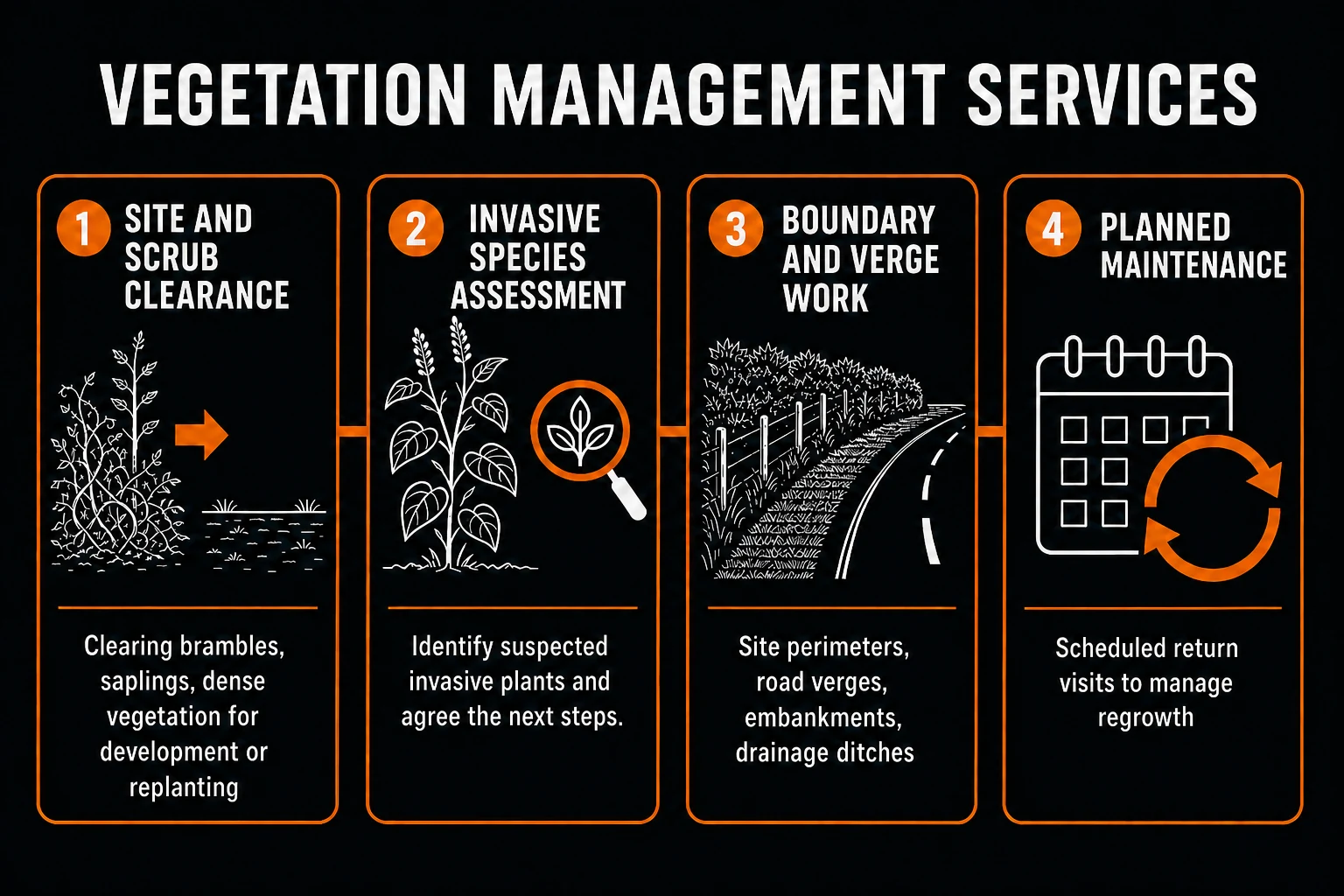
- Selective removal and edge management on reclaimed ground, old rail corridors and overgrown boundaries. See vegetation management.
- Stumps and hedges
- Stump grinding where services and ground allow, plus hedge reductions and staged work on hedges that have run away.
What the tree stock around Spennymoor actually is
Self-set woodland on the reclaimed colliery ground
Spennymoor was an ironworks and colliery town, with the works at Tudhoe and pits at Tudhoe, Whitworth and Page Bank. When the spoil was levelled and the sites capped and left through the 1970s and 1980s, most of the tree cover that followed seeded itself. Birch, goat willow, hawthorn, elder and sycamore came in thick and all at once, nothing thinned and nothing formatively pruned. Three things follow from that. Stems drawn up in competition have no taper, so when a neighbour comes out the tree left standing has no wind tolerance and often fails the next winter. Forked co-dominant stems with bark trapped in the union are everywhere, and that union is where these trees break. And birch on thin capped ground isn’t long-lived; plenty of it’s declining at an age when an oak would still be a sapling. The sensible answer is usually selective removal and a managed edge rather than clearing the lot.
The Wear at Page Bank, Byers Green and Croxdale
North and west of the town the river does something specific to trees: it takes the bank out from under them. Alder, willow and ash sit right on the edge, the water undercuts the outside of a bend, the root plate ends up half in air, and the tree leans and then goes. A leaning riverside tree with a lifted root plate isn’t a pruning job, and it’s rarely a machine job either, because the access is down a steep wooded bank. That means rigging, hand-carrying and often taking timber out in short lengths. Don’t walk under one to look at it. Japanese knotweed is common along river corridors and old industrial ground here; we can identify it and clear vegetation around it, but we don’t treat it, and treatment goes to a licensed specialist.
Whitworth and the old estate parkland
West of the town the Whitworth estate parkland is the other end of the scale: open-grown oak and lime with wide low limbs, some of them genuinely old trees. These are worth keeping, and the work is about keeping them standing rather than tidying them up. That means taking weight off the ends of the longest limbs over several visits instead of one hard reduction, leaving hollows and dead limbs alone where they threaten nobody, and accepting that a hollow trunk in an old tree is normal rather than a reason to fell. Programmes for grounds and estates run through tree maintenance.
Terraced streets, back lanes and shared boundaries
In Low Spennymoor, Tudhoe Colliery, Middlestone Moor and the older terraced streets the working area is a rear yard reached from a back lane, and that decides the method before anything else: whether a chipper gets through the gate at all, where the tipper stands, and whether the lane is part-blocked for a morning. Where the ground is made ground from reclamation, a stump grinder finds stone and clinker in it, which slows the job and wears cutters. We flag that at the assessment rather than discover it on the day.
Ash along the old wagonways and field boundaries
The disused railway lines that now run as footpaths towards Bishop Auckland, and the hedgerow boundaries out towards Kirk Merrington, Westerton and Hett, carry a lot of ash, and dieback has worked through most of it. Diseased ash is the one species where waiting makes the job harder rather than simply later: the wood goes brittle, it stops being safe to climb, and a tree that could have been dismantled from the crown one year has to be reached with a machine the next. See ash dieback removal.
Protected trees and conservation areas: Durham County Council
Spennymoor sits with Durham County Council for both Tree Preservation Orders and conservation-area notices; the old district council was abolished in 2009. A TPO tree needs a consent application. A qualifying tree in a conservation area needs a section 211 notice and a six-week period before cutting. Older village cores such as Tudhoe Village carry designation, and the boundary often runs along one side of a street, so we check it against the actual address rather than the postcode. In every case the Wildlife and Countryside Act 1981 makes it an offence to damage or destroy a bird nest while it is in use or being built. We check before cutting and stop if we find one.
What drives the price in Spennymoor
We quote per job after a site assessment, and we don’t publish a rate per tree because it would be wrong more often than right. Size, species and condition set the baseline. What moves it here is ground and access: back-lane and gate width, how far timber is carried, whether the ground carries a machine or the work is done on ropes, how much is lowered rather than dropped, the waste volume off a multi-stemmed self-set tree, whether buried fill slows a stump grinder, and whether a highway or a neighbour sits inside the working area. On a riverside or steep-bank job, getting timber out is often the biggest part of the day.
What isn’t included
Work outside the agreed trees, hedges and vegetation isn’t included, and nor is protected-tree work before consent. Stump grinding is quoted separately unless written into the scope. Storm work and hung-up trees go through fallen tree removal. Japanese knotweed treatment, ecology surveys, fencing, drainage and landscaping repairs aren’t ours. Nor is bank protection: we can take the tree off the bank, we can’t rebuild the bank.
Areas we cover
Spennymoor, Tudhoe, Tudhoe Village, Tudhoe Colliery, Tudhoe Grange, Middlestone Moor, Kirk Merrington, Westerton, Byers Green, Page Bank, Whitworth, Croxdale, Sunderland Bridge, Hett, Coxhoe, Cornforth, Bishop Middleham and Ferryhill. The town sits between two of our other areas: see Durham and Bishop Auckland.
See why a North East homeowner chose removal rather than reduction to bring more light into the garden.
Qualifications and cover. NPTC and LANTRA qualified. Constructionline Gold certified. £10M public liability insurance. Site-specific risk assessment and method statement. Written quote before work begins.
What customers ask
Common questions
Why do the trees on the old pit land keep splitting at the fork?
Because they seeded themselves and nobody ever pruned them. Self-set birch, willow and sycamore commonly grow with two competing stems and a strip of bark trapped in the union between them. That union is weak and it’s where the tree splits. It’s often visible from the ground, and it’s the first thing we look at on reclaimed ground.
A tree on the river bank is leaning over the water. How urgent is it?
Urgent enough not to stand under it. Bank erosion on the Wear undercuts root plates, and a tree that has lifted on one side won’t settle back. Send photographs from a safe distance, including the base and the bank below it, and tell us how close a path, fence or building is.
Which council deals with a protected tree in Spennymoor?
Durham County Council. Both the TPO register and section 211 conservation-area notices sit with the county council since the district council was abolished in 2009. Conservation-area work needs the notice and a six-week period before cutting; a TPO tree needs a consent application.
Should a big old oak with a hollow trunk come down?
Not automatically. Hollowing is a normal stage in a mature broadleaf and doesn’t by itself mean the tree is unsafe. What matters is what the tree could hit, how much sound wood is left around the hollow and whether the crown is still supported. Often the answer is reducing weight on the longest limbs over several visits instead of felling.
Can you treat Japanese knotweed along the river?
No, and we won’t claim otherwise. We can identify it, tell you what we’ve found and clear other vegetation around it without spreading material. Herbicide treatment and a management plan need a licensed specialist, and we’ll say so rather than take the work on.
Need a tree surgeon in Spennymoor?
Send the postcode, photos of the whole tree and its base, and tell us whether it’s in a garden, on a boundary, on old pit ground or down by the river. Each one changes the method.