You’ve the BS5837 tree survey back. It tells you which trees to keep and which ones need to go. It doesn’t explain the next steps on site.
Every developer and landowner hits this point. The consultant has done their job. Now the contractor has to do theirs. Here is what that looks like in practice.
What the four categories mean for your build
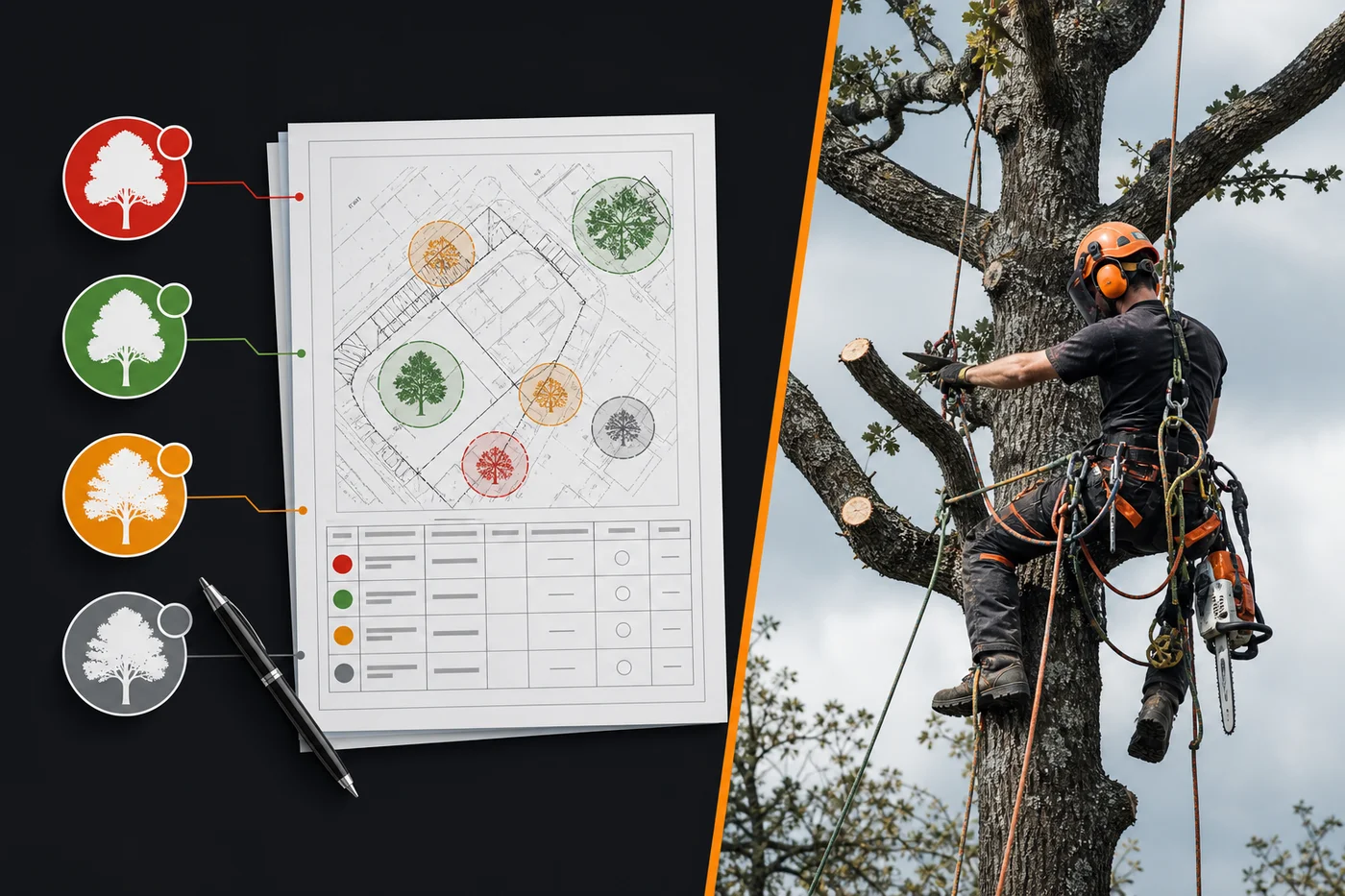
The survey sorts every tree on your site into one of four categories. Each one triggers a different action.
- Category U — Remove
- Trees that must come out. Dead, dangerous, or in the way of the approved building footprint. These removals happen before construction begins. We’re usually the first crew on site.
- Category A — Retain and protect
- High value trees that must be kept. We put up fencing and root protection zone barriers around them. Plant can’t go near them. This protection stays in place for the duration of the build.
- Category B — Retain where possible
- Good quality trees worth keeping. They might need pruning or crown reduction to clear space, but they come down only if they conflict with the final layout.
- Category C — Low priority
- Low value trees. They don’t need to stay. If they’re blocking an access route or a foundation, we remove them. Often the first to go when space is tight.
The survey dictates the plan. It will tell you exactly which trees fall into each group. Our job is to carry out that plan safely and efficiently.
A realistic programme for a commercial site
Timelines vary. A small domestic plot with a few trees can be a one-day job. A larger commercial site with a mix of protected and low-value trees takes longer.
For a typical two-acre site, the work might run like this:
Days 1-2: We install tree protection. This means fencing off root protection zones for any retained Category A and B trees. We set up the site and confirm access.
Days 2-4: Category U removals. We take down dead, dangerous, and development-conflicting trees. Sectional dismantling with ropes and rigging is common here.
Days 4-6: Category C removals. We clear the low-value trees blocking the build area.
Days 6-7: Work on retained Category B trees. This includes pruning, crown reductions, and removing deadwood.
Days 7-8: Waste removal. We chip timber on site, remove logs, and leave it tidy for the groundworks crew.
This is a guide. Every site is different.
What causes delays
Several practical factors affect how long the work takes.
Access is the biggest one. Can we get a tracked chipper and a MEWP through the gate? If not, we’ve to haul waste by hand or with smaller kit. This adds time and cost. We always visit the site to price the job because drawings don’t show you access constraints.
Trees close to buildings require care. A tree three metres from a wall can’t be felled in one piece. It needs to be taken down in sections, roped piece by piece. This is slower and more methodical.
Protected trees add a front-end step. Before we touch anything near a Category A tree, we need method statements and approved protection measures in place. This adds a day or two at the start but prevents a planning officer from halting the entire project later.
Ground conditions matter. Wet clay in winter is tough going. Dry summer ground is faster. We plan for the weather, but winter sites always run behind schedule.
Ecology pauses are non-negotiable. Nesting birds mean no work between March and August in occupied trees. A bat roost requires a licensed surveyor to clear the site. If your report flags either, the programme has to shift.
The equipment you’ll see
The kit depends on the job. A small garden removal might need a chainsaw, a chipper, and two of us.
A commercial clearance brings more. Tracked chippers for rough ground. MEWPs for high canopy work. Winches and rigging for dismantling near structures. A stump grinder for every tree that comes out.
We bring what the job needs. You don’t have to arrange any of it, but knowing what is coming helps you plan around it.
How we work from your survey
Most developers used to get the survey from an arboricultural consultant, then hire a separate tree surgeon for the work. Two companies, two site visits, and two sets of invoices to track.
We carry out the BS5837 survey ourselves — see Tree Surveys for Planning — then price and programme the removals, pruning and clearance the report calls for. One company handles it from there.
Tree removal, pruning, stump grinding and site clearance are all executed to the survey's recommendations.
What we need to quote the job
When you’re ready, send us the full BS5837 report, including the tree schedule and site plan. If there are Tree Preservation Orders or Conservation Area constraints, include that documentation.
We also need site access details. Tell us about gate sizes, weight limits, overhead cables, and neighbouring buildings. Finally, give us your construction programme. We need to know when the groundworks crew arrives so we can schedule our work first.
We’ll visit the site within a few days and provide a fixed quote. The price we quote is the price you pay.
See also: Site clearance for construction — the practical sequence after the survey work is done. And what site managers need to know about commercial tree surgery.
Got a tree that needs work?
We review the situation. We give you a fixed quote. No hidden costs. What we quote, you pay.