You manage a site with trees on it: an industrial estate, a business park, a school, or a retail unit with a car park and mature poplars along the boundary.
Those trees keep growing. They don’t pause because you’re busy, and that’s why commercial tree surgery matters.
A commercial tree surgeon has to work around live sites, site rules, and other trades, so commercial tree services need more planning, more paperwork, and tighter control than domestic tree work.
This is what you need to know before you call.
How commercial tree surgery is different
Domestic tree surgery is one homeowner, one garden, one afternoon. Commercial work is bigger, more formal, and often more complex.
1. Insurance. Many commercial sites ask for £10 million public liability. Most domestic tree surgeons carry £5 million. If your contract asks for £10 million, check before you book. We carry it.
2. Method statements. Every commercial job needs a site-specific risk assessment and method statement, or RAMS. It should be written for your site, not copied from a template. It covers access, plant, overhead cables, underground services, nearby properties, traffic control, and waste removal. You get it before work starts.
3. Programme. A domestic job fits around the homeowner. A commercial job fits around your site operations. We work evenings, weekends, and bank holidays when needed, because the aim is to cause the least disruption. The programme is agreed before any cutting starts.
4. Scale. A domestic garden might have three trees. A commercial site might have thirty. Each tree can have different limits. Buildings, car parks, paths, roads, boundaries, and services all affect the work. A tree 2 metres from a loading bay isn’t treated like a tree in an open field.
What to have ready before you call
The more you send before we visit, the faster we can price the job and build a programme.
Site plan. Send a drawing showing the site boundary, buildings, roads, paths, and the trees that need work. A marked-up copy is best. Even a Google Maps screenshot with circles around the trees helps.
Tree survey. If your site has a BS5837 survey, send it. If not, we can assess the trees during the site visit and tell you what needs doing.
TPO or Conservation Area status. Protected trees need consent before work starts. If you know a tree is protected, tell us upfront. If you don’t know, we check.
Service drawings. Send drawings for underground services near the trees: gas, water, and electric. If the tree is beside a main road, overhead cables matter too. We can’t dig out a stump if a gas main runs under it.
Access restrictions. Tell us about gate widths, weight limits, height limits, opening hours, and anything else that affects the kit we can bring. A 3-tonne chipper won’t fit through a standard pedestrian gate.
Your contact on site. We need someone who can let us in and sign off the work. If that’s you, fine. If it’s the security guard, tell us. We need to know who to speak to on the morning.
What a commercial programme looks like
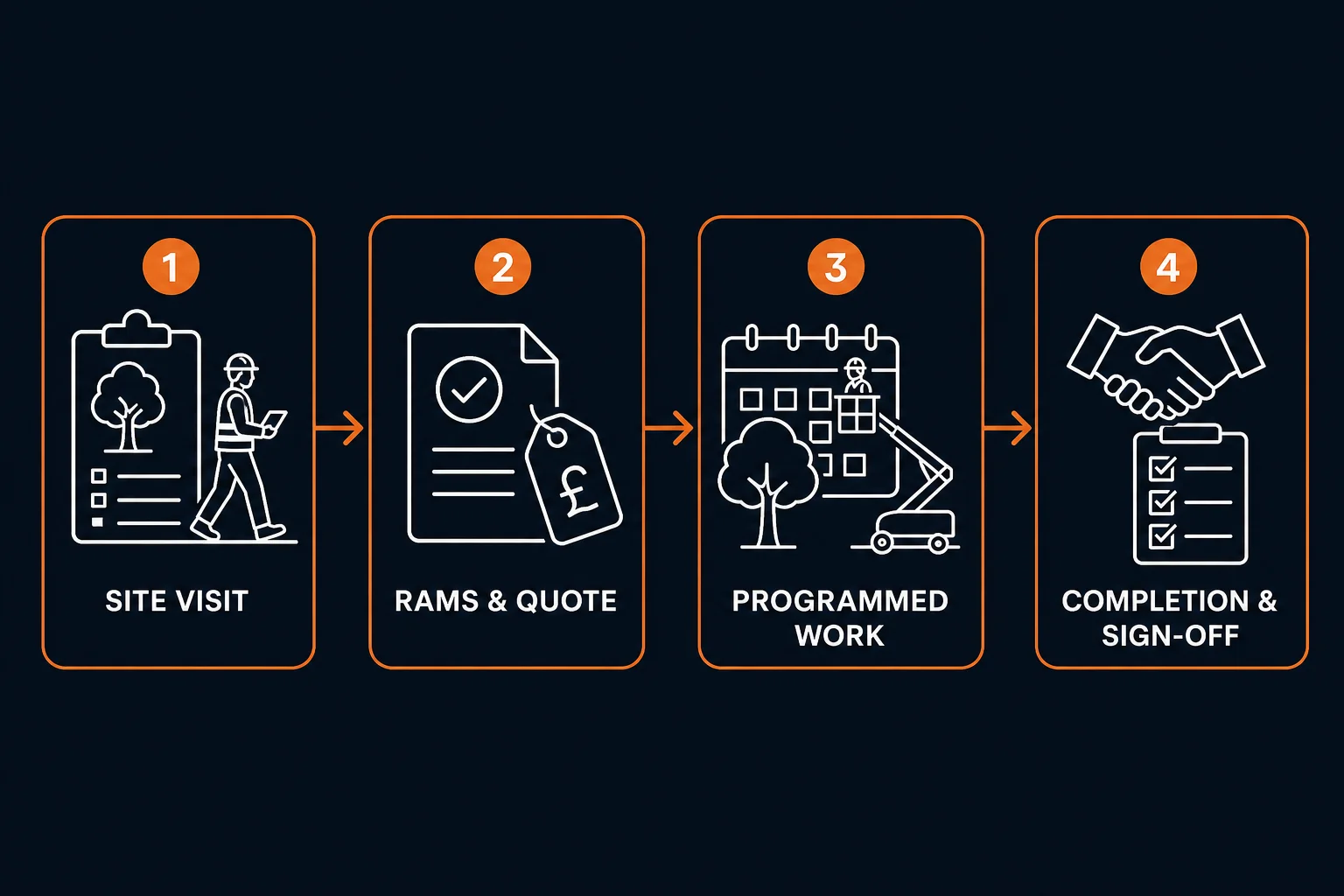
Every site is different, but a typical commercial tree services job for a business park with 15 to 20 trees looks like this:
Day 0. Site visit. We walk the site with you. You point to the trees. We explain what needs doing and why.
Within 3 days. Written quote. Fixed price. RAMS included.
Agreed date. Work starts, usually within 2 to 4 weeks of quote acceptance. Dead or dangerous trees may be dealt with sooner.
During work. We work around your site operations. Car parks stay open. Deliveries continue. The site stays live. If a tree blocks a fire escape, we deal with that first.
After work. We remove all waste and leave the site clean. You get a completion note that lists what was done and when. If a tree should be checked again in 12 months, we say so.
What you don’t need to worry about
You don’t need to arrange traffic control. We handle it.
You don’t need to arrange waste disposal. We take everything away.
You don’t need to close the site. We work around you.
You don’t need to know what a crown reduction is. If a tree needs one, we explain it in plain English and give you a price.
Ongoing maintenance
Most commercial sites benefit from a maintenance visit every 12 months. Trees grow. Deadwood appears. Hedges get shaggy. An annual check catches problems before they turn into expensive repairs or insurance claims.
We offer scheduled maintenance visits. The price is fixed per visit. There’s no contract. We call when the work is due. If you want us to come, we book it. If you don’t, fine.
Good maintenance is easy to miss because nothing goes wrong. The trees look tidy. The car park stays clear. Nobody notices until the work isn’t done.
See also
After the BS5837 tree survey: what happens next — how tree categories drive the work.
Site clearance for construction — the practical sequence when trees need to come out before building starts.